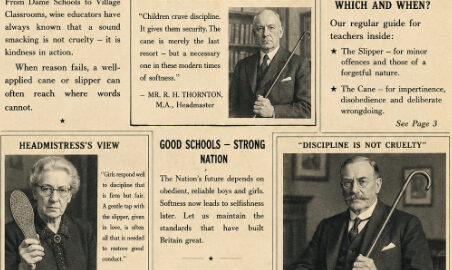
The evidence indicates that schools did not always apply identical disciplinary arrangements to boys and girls.
In some establishments both sexes could receive corporal punishment.
In others, the method differed.
The distinction might concern the implement, the number of strokes or the manner in which punishment was administered.
Different Methods
One contributor who attended a Catholic primary school in Lancashire during the 1960s recalled that girls received the cane on the hand while boys were punished differently.
The contributor remembered one or two strokes being common for classroom offences such as talking.
Whatever judgement is made about the practice itself, the account illustrates an important feature of school discipline at the time: equal rules did not necessarily mean identical punishments.
Ideas About Toughness
Boys were often expected to display toughness.
A boy who cried following punishment could fear ridicule from classmates.
This social pressure could cause pupils to make considerable efforts to conceal distress.
Some later remembered with pride that they had accepted punishment without tears.
Such pride should not be interpreted as evidence that the punishment was mild.
It tells us instead about expectations surrounding masculine behaviour.
A boy might regard showing pain as more embarrassing than receiving the punishment itself.
Girls and Discipline
The available evidence concerning girls is less extensive.
This creates a problem for the survey.
A smaller number of female accounts does not necessarily prove that girls were rarely corporally punished.
It may reflect differences between schools, differences in disciplinary methods or simply the composition of those who supplied recollections.
We should therefore avoid conclusions which the evidence cannot support.
What can be said is that corporal punishment of girls certainly occurred in some schools and that its form could differ from that applied to boys.
Mixed Schools
Mixed schools created further questions.
Should boys and girls receive the same punishment for the same offence?
Some teachers evidently believed they should.
Others did not.
One recollection describes boys and girls being punished together when an entire class was disciplined.
In other accounts, sex influenced the method used.
These variations again demonstrate the absence of a uniform national practice.
The Influence of School Tradition
Much depended upon tradition.
A boys’ grammar school might possess disciplinary customs established over many years.
A girls’ school might have entirely different arrangements.
A mixed secondary school might develop another system again.
Teachers entering such establishments inherited these traditions.
Some followed them.
Others modified them.
A Necessary Caution
It would be easy to impose present-day assumptions upon these recollections.
The purpose of this survey is different.
Its task is to establish, as accurately as the available evidence permits, what happened and how those involved understood it.
The evidence shows variation rather than uniformity.
Sex mattered in some schools.
In others it mattered less.
The only safe conclusion is that corporal punishment must always be considered within the particular culture of the school in which it occurred.