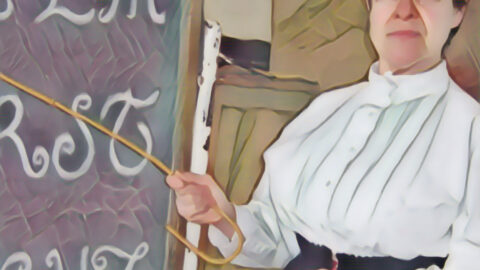
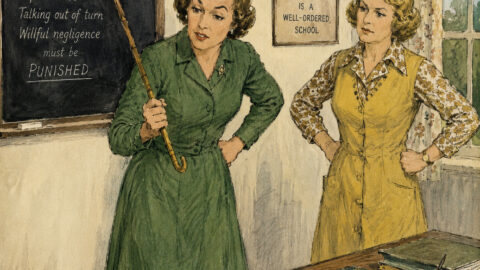
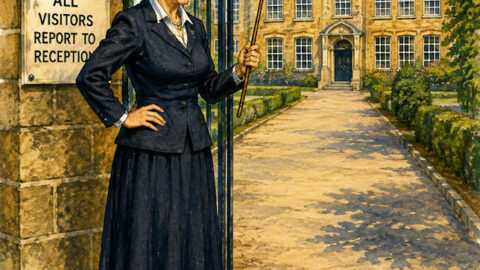
Corporal punishment did not exist separately from ordinary school life.
It occurred between mathematics and geography, during physical education, after assembly, in corridors and occasionally after the final lesson of the day.
The timing and location of punishment influenced the pupil’s experience.
During the Lesson
The most immediate punishment took place during the lesson itself.
A teacher could stop proceedings, call an offender forward, administer the punishment and then instruct everyone to continue working.
For the pupil concerned, this created an abrupt transition.
One moment he was part of the class.
The next he was its centre of attention.
Minutes later he was expected to return to his desk and continue as though nothing unusual had occurred.
Between Lessons
Punishment between lessons produced different difficulties.
One grammar-school pupil remembered being caned during a change of lessons.
Afterwards he had to return the cane and punishment book to the office.
By the time he reached his next lesson he was late.
The teacher demanded an explanation, and the pupil had to admit that he had been caned.
The disciplinary consequences therefore followed him beyond the room in which the punishment occurred.
The Corridor
Corridors were themselves common sources of trouble.
Running was forbidden in many schools for obvious safety reasons.
Yet pupils late for lessons naturally hurried.
One contributor described precisely this dilemma.
He ran because he feared being late and receiving punishment from his classroom teacher.
Unfortunately, he encountered the deputy head while running and was punished for that instead.
The attempt to avoid one disciplinary problem had created another.
Physical Education
The gymnasium and changing room occupy a noticeable place in the recollections.
Physical education produced opportunities for noise, horseplay and failure to obey instructions.
Teachers responsible for physical education also had to maintain safety in circumstances where reckless behaviour could result in injury.
Several contributors remember the slipper being associated particularly with this part of school life.
The readily available gym shoe provided an obvious implement.
After School
A punishment imposed near the end of the day created another consideration.
The pupil was about to go home.
If parents discovered what had happened, another explanation might be required.
For children from particularly strict households, this possibility could be almost as worrying as the school punishment.
Discipline as Part of Routine
These details remind us that corporal punishment was not an isolated ceremony.
It existed within the ordinary timetable.
The bell still rang.
Lessons continued.
Homework still had to be completed.
A pupil might receive punishment in the morning and be playing football with friends that afternoon.
This ordinariness is perhaps difficult to appreciate when examining the subject many years later.
For those attending schools where corporal punishment was regularly employed, however, it could simply be another possibility within the working school day.