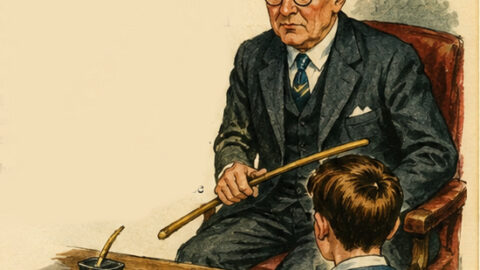
A survey of corporal punishment naturally concentrates upon those who received it.
Yet this creates an important distortion.
The majority of the disciplinary influence may have fallen upon pupils who were never physically punished at all.
Watching Others
A child did not need personal experience of the cane to understand its meaning.
He might see classmates punished.
He might notice boys waiting outside the headmaster’s office.
He might hear stories from older pupils.
From these sources he developed an understanding of what would happen if he broke certain rules.
Reputation as Deterrence
One contributor stated that he was never caned at school, although he remembered the school’s system clearly.
The headmaster administered formal canings, another teacher was normally present, and pupils knew the range of punishment that could be imposed.
The contributor’s recollection demonstrates an important point.
A disciplinary system can influence someone who never personally experiences its strongest sanction.
The Invisible Success
Suppose a pupil considers smoking behind the bicycle sheds but decides against it because he knows what happened to another boy who was caught.
Nothing appears in the punishment book.
No incident occurs.
Yet the threat has apparently worked.
This is what might be called the invisible side of deterrence.
We can count punishments.
We cannot easily count offences which never happened because pupils feared punishment.
Naturally Well-Behaved Pupils
Of course, not every unpunished child was deterred by corporal punishment.
Some pupils simply had little inclination to break serious rules.
Others responded to warnings, parental expectations or personal standards.
It would therefore be equally wrong to assume that every well-behaved pupil owed his conduct to fear of the cane.
The Difficulty for the Survey
This presents a fundamental difficulty.
The questionnaire asks former pupils about punishments they received.
It consequently provides rich information about offenders but much less information about those who avoided punishment throughout their school careers.
The resulting picture may therefore make corporal punishment appear more central to everyday school life than it seemed to the average pupil.
Discipline Without Punishment
A successful disciplinary system is not necessarily one which administers large numbers of punishments.
Indeed, the opposite may be true.
If pupils know the rules, respect teachers and believe that serious consequences will follow misconduct, actual punishment may be comparatively rare.
The existence of a sanction can influence behaviour without the sanction being used.
For this reason, statistics showing how many pupils were caned cannot by themselves tell us how influential the cane was.
Its greatest influence may sometimes have been upon the child who never received it.