The most serious punishments at St Bartholomew’s School took place in the study of the headmistress, Miss Beatrice Blyton.
To the younger pupils, that quiet room seemed almost legendary. Few ever entered it, and those who did rarely forgot the experience.
A girl summoned to the headmistress’s study would first report to the secretary’s office, where she would be asked to wait.
Outside the heavy oak door stood a single polished wooden chair that had served generations of anxious pupils. Beside it rested a small table bearing several faded copies of the school magazine, their edges worn from age rather than use.
No one ever read them.
Most simply sat in silence, listening.
The corridor itself seemed unnaturally quiet. Somewhere a grandfather clock ticked away the seconds with almost painful precision. Occasionally the distant sound of a classroom reciting Latin verbs or practising hymns drifted faintly through the building, making the silence outside the study feel even heavier.
The polished floorboards gleamed beneath the afternoon sunlight, and every footstep seemed louder than it really was.
Some pupils clasped their hands together.
Others stared at the floor.
Many silently replayed the events that had brought them there, wondering whether honesty would help or simply make matters worse.
Eventually the secretary would look up from her typewriter and quietly announce,
“Miss Blyton will see you now.”
The great oak door would open.
Inside, the study was impressive without being luxurious. A large stone fireplace occupied one wall, although it was only lit during the coldest months of winter. Shelves filled with well-used books stretched almost to the ceiling, while framed photographs of former pupils, school plays and prize-winning sports teams decorated the walls.
Near the windows stood two visitor’s chairs facing a broad mahogany desk that was always perfectly tidy. Every pen lay parallel. Every document rested squarely in its place. Even the blotter seemed incapable of being out of line.
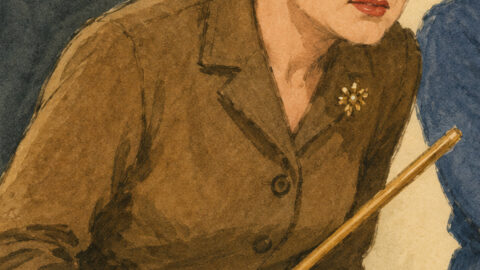
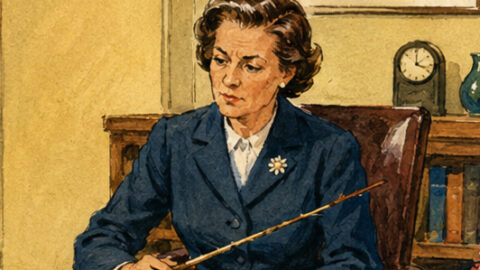
Behind the desk sat Miss Beatrice Blyton.
She was never hurried.
She never raised her voice.
She simply looked over the rim of her spectacles and waited.
That silence often proved more unsettling than any shouted reprimand.
Only when she was satisfied that the room had become completely still would she speak.
“Now then… tell me exactly what happened.”
She insisted that every pupil had the opportunity to explain herself.
She listened without interruption, occasionally making a brief note with her fountain pen.
Yet Miss Blyton possessed an extraordinary ability to recognise when a story had been carefully rehearsed.
A pupil caught smoking behind the bicycle sheds might nervously explain that she had merely been holding a cigarette for another girl.
Miss Blyton would slowly raise a single eyebrow.
“So you considered that a sensible decision?”
The silence that followed usually encouraged a rather different version of events.
Another girl discovered wandering beyond the school gates without permission might insist that she had simply lost track of time.
Without speaking, Miss Blyton would turn slightly in her chair and gesture towards the great school clock, visible from almost every corner of the playing fields.
“It has been keeping excellent time all afternoon.”
There was rarely any need for further questioning.
Miss Blyton valued honesty above almost everything else.
She could forgive foolishness.
She could forgive poor judgement.
She even believed that children sometimes acted impulsively.
What she found far harder to overlook was deliberate dishonesty.
Once the facts had been established, she explained the school’s decision calmly and without emotion.
There was never any shouting.
Never any dramatic speeches.
The punishment was delivered as a consequence rather than an outburst.
The school cane was used only on the rarest occasions, and precisely because it was seldom seen, it carried enormous significance throughout the school.
Its use was reserved for offences considered serious challenges to the school’s discipline and authority.
Repeated truancy.
Theft.
Bullying.
Dangerous behaviour that endangered others.
Smoking.
Wilful and repeated disobedience.
Persistent dishonesty despite previous warnings.
Such matters were never dealt with lightly.
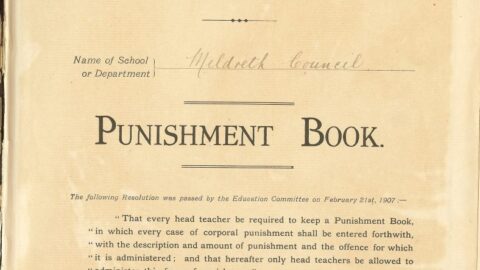
Every instance was carefully entered into a large leather-bound punishment register kept securely inside a locked drawer of Miss Blyton’s desk.
Each entry was written in neat, elegant handwriting.
The date.
The pupil’s full name.
The offence.
The number of strokes administered.
Nothing more.
Nothing less.
To Miss Blyton, discipline was never intended to humiliate.
It existed to reinforce responsibility.
She often reminded newly appointed members of staff,
“No child should ever be punished in anger. The moment temper enters discipline, discipline has already failed. Self-control must belong to the teacher before it can ever be expected from the child.”
It was a principle she observed throughout her career.
Although pupils naturally feared being summoned to the study, many later admitted that Miss Blyton’s fairness earned a quiet respect.
She expected high standards because she believed her pupils were capable of meeting them.
Years later, former pupils frequently discovered that their strongest memory was not the punishment itself.
Instead, they remembered the journey.
The slow walk along the polished corridor.
The steady ticking of the old clock.
The secretary’s reassuring but measured voice.
The scent of furniture polish and old books.
The quiet creak of the study door opening.
And above all, the composed figure of Miss Beatrice Blyton waiting patiently behind her desk, where discipline, fairness and duty had guided generations of girls through the changing years of St Bartholomew’s School.