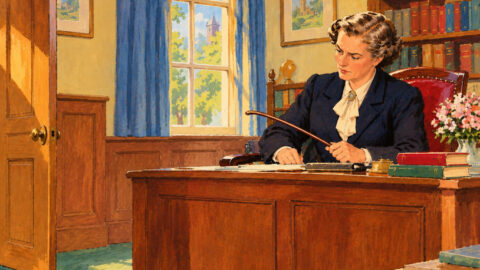
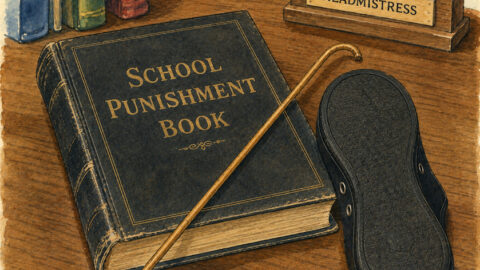
The evidence gathered in this survey describes a school world in which corporal punishment could occupy a recognised place within ordinary discipline.
It is important to understand that world on its own terms.
The purpose of historical enquiry is neither to romanticise the past nor to condemn it without examination.
It is to discover what happened, why people acted as they did, and how those involved understood their experiences.
Accepted Authority
Many contributors describe corporal punishment without suggesting that its existence surprised them.
They knew that particular offences could result in the cane, slipper, strap or ruler.
Their parents often knew it too.
This does not mean that every punishment was approved.
Parents sometimes complained.
Pupils sometimes considered themselves unfairly treated.
Teachers disagreed about methods.
But the basic existence of corporal punishment formed part of the disciplinary assumptions of many schools represented in the recollections.
The Teacher’s Responsibility
Such authority placed considerable responsibility upon teachers.
A teacher using corporal punishment made several judgements.
Had the pupil committed the offence?
Was punishment necessary?
What form should it take?
How severe should it be?
Should it be public or private?
A mistake at any stage could turn discipline into injustice.
The greater the authority given to the teacher, the greater the importance of restraint and judgement.
Different Memories
Former pupils do not speak with one voice.
Some believe that corporal punishment maintained discipline effectively.
Some consider particular punishments useful but reject others.
Some remember injustice.
Some remember fear.
Others treat the whole subject as simply part of school life.
This variety should not be regarded as a weakness in the evidence.
It is itself an important finding.
There was no single experience of school corporal punishment.
What the Survey Reveals
Taken together, the accounts reveal several recurring features.
Corporal punishment ranged from minor classroom correction to formal punishment by the head.
The cane, slipper, strap and ruler were all used.
The seriousness of punishment varied greatly.
Teachers exercised considerable discretion.
Public punishment could involve embarrassment and peer pressure.
Private punishment could involve prolonged anticipation.
Parental reaction could reinforce or challenge the school’s decision.
And effectiveness varied from pupil to pupil.
The Central Difficulty
The central difficulty remains measurement.
We can count recorded punishments.
We can collect recollections.
We can compare schools.
But we cannot recreate every classroom or recover every unrecorded incident.
The historical record will always be incomplete.
This should encourage caution rather than speculation.
Where the evidence is strong, conclusions may be drawn.
Where it is weak, uncertainty should be admitted.
That principle is especially important with a subject so capable of producing strong opinions.
The purpose of a survey is not to decide in advance what the evidence ought to show.
It is to examine what the evidence actually shows.
And in the case of school corporal punishment, what it shows above all is diversity: different schools, different teachers, different pupils—and very different memories of the same disciplinary system.