Looking back at the years leading up to 1987, I always considered myself to be well informed about what was happening at MGS. Pupils tended to know when someone had been sent to the headteacher’s office for a caning, and news of serious punishments travelled remarkably quickly around the school. Based on what I knew at the time, I estimated that around 25 canings took place across the entire school during my seven years there. Even after all these years, that figure still feels broadly accurate.
Of course, memory is never perfect. It is entirely possible that during my first couple of years I was less aware of everything that happened, particularly involving older pupils or incidents outside my own year group. Even if another 25 canings escaped my attention, that would still amount to only around 50 canings over seven years.
Spread across that period, this works out at just over seven canings a year. Considering that there were approximately 750 to 775 pupils eligible for corporal punishment, excluding the sixth form, the likelihood of any individual pupil receiving the cane in a given year was well under one percent. Contrary to the impression sometimes given in popular culture, being caned was an exceptional event rather than an everyday occurrence. Most pupils completed their entire school career without ever experiencing it.
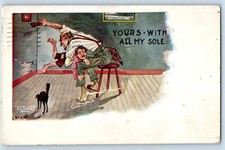
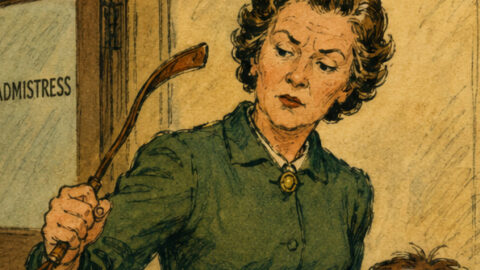
When I compared experiences with friends who attended the local technical college or neighbouring secondary schools, a slightly different picture emerged. They often spoke of classroom punishments, particularly slipperings administered by individual teachers. These were generally carried out by classroom staff, the vast majority of whom were women, while a smaller number of men also retained the authority to use such punishments. Overall, around four out of every five teachers involved in day-to-day discipline were female, with the remaining one in five being male.
Although classroom slipperings were more common in those schools than at MGS, referrals to the headteacher for caning were only modestly higher. Recalling conversations from more than forty years ago, I would estimate that schools of around 600 pupils averaged perhaps 15 to 18 canings each year. Even then, the statistical chance of any individual pupil being caned remained relatively low, at roughly three percent annually.
Most of the local secondary modern schools were mixed schools. However, not all of them administered corporal punishment to girls. Where they did, boys were generally punished much more frequently, perhaps three times as often. As a result, a girl such as Jenny attending one of those schools would probably have faced a similar overall likelihood of receiving corporal punishment as I did while attending MGS.
Practices also varied considerably depending on the region of the country. In some inner-city schools, particularly in parts of London, Manchester and Liverpool, members of the teaching staff responsible for supervising lunchtime frequently carried the recognised implement of punishment as part of their normal duties. In London this was often a cane, while in Manchester and parts of Liverpool the strap remained in use for longer. This enabled immediate punishment for serious breaches of discipline without the need to wait for a formal referral to the headteacher.
At MGS, however, discipline around the school grounds generally followed a different pattern. Areas such as the toilets were monitored by prefects, who were expected to discourage smoking and other rule-breaking. Whether they always fulfilled that responsibility as intended is another matter entirely, as pupils often joked that some prefects reached these places before anyone else for reasons of their own.
For many years I believed that corporal punishment in schools had largely disappeared by around 1980. Looking back more carefully, and comparing memories with those of pupils from other schools, it now seems that this was not the case. In fact, levels of corporal punishment during the mid to late 1970s appear to have remained relatively high, in some respects matching or even exceeding those seen during the 1950s.
This resurgence was directed overwhelmingly at boys. Although some schools still punished girls, many had already begun reducing or abandoning the practice for female pupils well before it declined for boys. As a consequence, by the late 1970s corporal punishment had increasingly become something associated with male discipline, even though exceptions continued to exist.
The picture changed noticeably by around 1982 or 1983. Across many schools, the number of routine or relatively minor canings fell dramatically. The days when pupils expected corporal punishment for a wide range of offences were rapidly becoming part of school folklore. Increasingly, schools reserved the cane for the most serious disciplinary cases involving deliberate defiance, persistent antisocial behaviour or repeated breaches of school rules.
At the same time, wider social and political attitudes were changing. Public debate increasingly focused on children’s welfare, educational reform and the rights of young people. Questions began to be asked about whether physical punishment had any place in modern education, and schools found themselves under growing pressure to justify practices that had once been accepted without question. These changing attitudes would eventually lead to the complete abolition of corporal punishment in state schools.
One comparatively minor issue that never attracted the same level of attention was lateness. At MGS, pupils who arrived late for morning assembly were not subjected to corporal punishment. Instead, they simply entered quietly after everyone else and took their places in a designated area at the back of the hall. Alongside them were pupils who had been excused from the main assembly for religious reasons, including Catholics, Jewish pupils, members of other Christian denominations and those from other faith communities. The arrangement was practical rather than punitive and reflected the school’s routine approach to managing the start of the day.