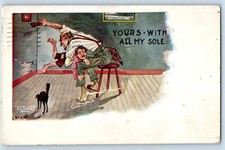
The surviving punishment register from Catford Central School for Boys, London, England, provides a rare opportunity to examine the administration of corporal punishment within a British secondary school during the 1950s. Rather than relying on personal recollections or anecdotal evidence, the register records individual punishments, offences, dates, ages, and the number of strokes administered. This makes it possible to identify consistent disciplinary practices and to examine whether punishments followed recognisable patterns.
Although the overall volume of canings initially appears high, closer examination reveals a more nuanced picture. The records suggest that punishments were not administered randomly but instead reflected several identifiable considerations, including the pupil’s age, the seriousness of the offence, and whether the pupil had previously been punished.
Punishment by Age
Table 2 provides insight into both the frequency and severity of canings across different age groups. One noticeable feature is the reduced number of entries for sixteen-year-olds. This is almost certainly explained by the fact that relatively few pupils remained at school beyond that age, resulting in a smaller sample rather than a reduction in disciplinary activity.
Several clear trends emerge from the data.
The most common punishment by a considerable margin was two strokes, accounting for approximately 56% of all recorded canings. One stroke represented around 24% of punishments, while the frequency of three or more strokes declined progressively as the number of strokes increased. This suggests that the school generally favoured moderate punishments, reserving heavier canings for more serious or repeated misconduct.
Among eleven-year-old boys, over half of all punishments consisted of a single stroke. Approximately 54% of canings in this age group were limited to one stroke, indicating that younger pupils were generally treated more leniently. This may reflect an intention to establish discipline early while recognising that new pupils were still adjusting to the school’s expectations. For many boys, a single caning appears to have been considered sufficient to reinforce acceptable behaviour.
One remarkable exception stands out. An eleven-year-old boy recorded elsewhere in the register received thirteen separate canings, making him a clear statistical outlier whose behaviour differed dramatically from that of the majority of his contemporaries.
Increasing Severity with Age
Perhaps the clearest trend shown in the data is the relationship between age and punishment severity.
As pupils became older, they were increasingly likely to receive larger numbers of strokes. Only 46% of eleven-year-olds received two or more strokes during a punishment, whereas this figure rose steadily with each successive age group until reaching 94% among sixteen-year-olds.
A similar progression can be observed for punishments involving three or more strokes and four or more strokes. The increase is sufficiently consistent to suggest that age itself formed an important component in determining punishment.
This pattern probably reflected the belief that older boys bore greater personal responsibility for their behaviour and therefore deserved more severe disciplinary measures when they failed to meet expected standards.
The records also show that the most severe punishments generally began to appear only from the age of thirteen onwards. Four- and six-stroke canings are rare among younger boys but become increasingly common among older pupils.
Truancy illustrates this particularly well. Before the age of fourteen, isolated cases of truancy generally attracted comparatively moderate punishments. From fourteen onwards, however, truancy almost invariably resulted in the maximum punishment of six strokes, suggesting that persistent absence from school was regarded as one of the gravest disciplinary offences.
Frequency of Canings per Boy
Table 3 demonstrates that repeated corporal punishment was relatively uncommon.
Approximately 45% of boys who were caned experienced the punishment only once during the period covered by the register. Around 65% received only one or two canings, while roughly three-quarters were never punished more than three times.
These figures suggest that, for most pupils, corporal punishment was an infrequent event rather than a routine aspect of school life.
Whether this indicates that caning functioned as an effective deterrent remains open to interpretation. However, the statistics do suggest that the majority of boys did not repeatedly commit offences serious enough to warrant further corporal punishment.
At the opposite end of the scale was a very small group of persistent offenders.
Approximately 5% of caned boys were punished nine or more times, while only three pupils, representing roughly 0.5% of all boys who were caned, received twenty or more separate canings.
These individuals accounted for a disproportionately large share of the entries in the punishment register.
Persistent Offenders
The register indicates that certain serious offences, particularly truancy, were concentrated among a relatively small number of repeat offenders.
In these cases, corporal punishment appears to have produced only temporary improvements in behaviour before further offences occurred.
An interesting observation emerges when comparing the intervals between repeated punishments. Contemporary accounts suggest that a severe six-stroke caning could leave bruising that lasted for as long as two weeks. Although impossible to prove from the records alone, it is notable that many repeat offences occurred only after a period broadly corresponding with the expected healing time.
The most striking exception concerns a fourteen-year-old boy who received six strokes for truancy on 18 November 1954 and then committed the same offence again only four days later, receiving another six-stroke punishment on 22 November.
While this single example cannot support broader conclusions, it illustrates that even the maximum available punishment did not always prevent immediate reoffending.
Group Punishments
Most entries concern either individual pupils or very small groups involved in the same incident.
Occasionally, however, considerably larger groups were punished together.
These incidents generally related to academic rather than behavioural failings, particularly poor effort or failure to complete assigned work. One recorded example involved nine fifteen-year-old boys from the same classroom, each receiving two strokes for failing to complete their work satisfactorily.
Notably, no examples were found of an entire class receiving corporal punishment simultaneously. Even in group cases, punishment appears to have been restricted to those directly involved.
Escalation Following Previous Canings
Another pattern became apparent during examination of the register, although it is less obvious in the numerical summaries alone.
Pupils receiving their first caning often appeared to benefit from a degree of leniency. First offences frequently resulted in a single stroke, particularly among younger boys.
Once a pupil had previously been caned, however, subsequent offences often attracted larger punishments.
Examples occur repeatedly among eleven- and twelve-year-olds, who commonly received one stroke for an initial offence but two—or occasionally more—for later offences of similar seriousness.
This suggests that previous disciplinary history formed an important consideration when deciding the number of strokes to administer.
Escalation for Repeated Misconduct
The register also indicates that repeated commission of the same offence frequently resulted in progressively harsher punishment.
One particularly clear example involved two fourteen-year-old boys punished with three strokes each for copying schoolwork.
Only two days later they repeated exactly the same offence.
This time both boys received four strokes.
No further entries for copying were subsequently recorded for either pupil, suggesting that the increased punishment may have achieved its intended effect, although the records naturally cannot confirm the reason.
The broader pattern nevertheless indicates that escalating punishment formed part of the school’s disciplinary philosophy, with repeated misconduct generally attracting progressively greater severity.
Types of Offences
The offences recorded in the register are broadly typical of those found in mid-twentieth-century British schools.
Most relate to everyday disciplinary matters, including:
- Disobedience
- Failure to complete assignments
- Poor-quality work
- Truancy
- Bullying
- Vandalism
- Talking during assembly
- Smoking
- Climbing school buildings or structures
- Entering prohibited areas
Occasionally, more unusual entries appear.
One twelve-year-old boy, for example, received three strokes for participating in what was recorded simply as a “disgusting game in the lavatory.”
Unfortunately, the register provides no further explanation of the incident.
Conclusions
Taken as a whole, the register suggests that corporal punishment at Catford Central School for Boys followed identifiable and relatively consistent patterns rather than being administered arbitrarily.
Although the school averaged approximately three canings per school day, the majority of pupils experienced corporal punishment only once or twice during their time at the school. The typical punishment consisted of two strokes administered to the seat, with substantially heavier punishments reserved for older boys, repeat offenders, or more serious offences.
Three principal factors appear to have influenced the severity of punishment:
- The age of the pupil, which was the strongest predictor of the number of strokes.
- The seriousness of the offence, with truancy consistently attracting the harshest penalties.
- Previous disciplinary history, with repeat offenders generally receiving progressively heavier punishments.
The consistency of these relationships suggests that punishments were not determined solely by the immediate offence but formed part of a broader disciplinary framework in which staff exercised discretion according to established expectations.
The register also highlights a very small group of persistent offenders who accumulated exceptionally large numbers of canings. In particular, boys receiving more than twenty canings over a relatively short period raise important questions. In such cases, corporal punishment clearly failed to produce lasting behavioural change, suggesting that other underlying educational, social, or personal factors may have been contributing to their repeated misconduct.
Viewed statistically, the register portrays a disciplinary system that relied heavily upon corporal punishment but employed it with recognisable gradations of severity. Whether that system was effective or justified remains a matter of historical interpretation, but the surviving records provide valuable evidence of how school discipline was administered in practice during this period.