Among those who experienced corporal punishment in British schools, there has long been discussion about the durability and handling characteristics of the school cane. While individual experiences varied considerably from one school to another, a number of common observations emerge regarding how canes were selected, maintained and used by teaching staff.
One recurring topic concerns the tendency of some canes to split at the tip. Many former pupils recall that the majority of rattan school canes remained intact throughout their working life, even after prolonged use. However, there were certainly instances where a cane developed a split near its striking end. In many cases, this was probably not the result of normal use against a pupil’s hand or clothing but rather from repeated contact with hard surfaces such as desks, chairs or classroom furniture.
Some schools appear to have relied on inexpensive bamboo garden canes rather than purpose-made educational canes. These makeshift substitutes generally lacked the strength and flexibility of properly prepared rattan and were much more susceptible to splitting and fraying after relatively little use. Once damaged, the split fibres could make the cane unpredictable in its behaviour, prompting some teachers to replace them as a precaution.
One experienced male headmaster at a London secondary school provides an interesting example. After noticing that the tip of his regular cane had begun to split, he became concerned that it might mark or cut a pupil rather than deliver the clean stroke for which a properly maintained cane was intended. Rather than continue using damaged equipment, he ordered a heavy leather tawse instead. According to his own account, he found it an effective alternative and continued using it in preference to replacing the cane.
In Scotland, where the tawse was traditionally far more common than the cane, teachers often developed different classroom habits. Several former pupils recalled that female teachers, as well as male colleagues, would occasionally bring the tawse or even a leather belt down sharply onto the top of a desk to restore order or capture the attention of a noisy class. The resulting crack echoed around the classroom and could instantly silence even the most distracted pupils. Although startling, the action was intended more as a demonstration of authority than as a punishment in itself, and the heavy leather was robust enough to withstand such treatment repeatedly. Whether a rattan cane would have survived similar repeated impacts without damage is open to question.
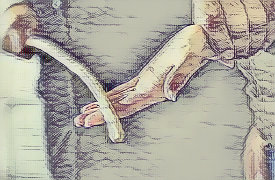
The flexibility of school canes is another aspect that frequently attracts attention. Purpose-made rattan canes possessed remarkable resilience and could often be bent into an impressive arc without breaking. Many former pupils remember seeing a teacher flex a cane before use, either to demonstrate its suppleness or simply as a habitual gesture. The amount of flexibility, however, depended greatly on the thickness of the cane.
A light cane measuring around 6 mm in diameter could usually be bent into a pronounced curve with relative ease, almost resembling a half-moon, while still returning to its original straight form. By contrast, heavier examples of 10 to 12 mm were considerably stiffer. These thicker canes delivered a more solid stroke but naturally resisted bending to the same extent. Their greater rigidity also made them less vulnerable to permanent deformation during normal classroom use.
Teachers differed considerably in how they handled the cane. Some routinely flexed it before administering punishment, perhaps to reassure themselves that it remained sound and free from defects. Others simply removed it from its storage place and proceeded without ceremony. Whether this brief flexing served any practical purpose or merely reinforced the seriousness of the moment remains a matter of personal interpretation.
Individual schools sometimes developed reputations based upon the equipment favoured by particular members of staff. At Aylesford Secondary School, for example, one male geography teacher became well known among pupils for continuing to use canes that had developed split ends. Whether this reflected economy, personal preference or simple indifference is impossible to say, but his reputation endured long after individual incidents had been forgotten. It also illustrates how practices could differ significantly from one school to another, depending largely on the judgement of the teacher involved.
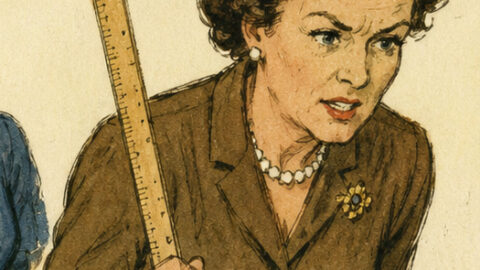
Not every use of a cane or pointer was connected with corporal punishment. Many teachers, particularly female teachers, preferred to use long rattan pointers during lessons to indicate locations on maps, highlight mathematical workings or direct attention to information written on the blackboard. These lightweight pointers were handled daily and, unlike disciplinary canes, were simply classroom tools.
One memorable incident involved a mathematics lesson in which a male teacher habitually struck the blackboard sharply with his rattan pointer whenever he wished to regain the class’s attention. The action produced a sharp report that immediately focused wandering minds without any suggestion that corporal punishment was about to follow. On one occasion, however, years of repeated impacts finally took their toll. As the pointer struck the board, the front section—approximately nine inches from the end of the three-foot length—snapped cleanly away and shot across the classroom.
A quick-thinking pupil instinctively caught the flying section before it could strike anyone. The episode became a source of amusement rather than alarm, and the catch itself was remembered with considerable pride. More importantly, it served as a reminder that even rattan, renowned for its toughness and flexibility, had practical limits when subjected to repeated impacts against hard surfaces.
Taken together, these recollections suggest that the longevity of a school cane depended less upon its use during corporal punishment than upon the quality of its manufacture, the material from which it was made and the way it was treated between punishments. Purpose-made rattan canes were remarkably durable when properly maintained, whereas cheaper bamboo substitutes were far more prone to splitting. The experiences also demonstrate the wide variation in classroom practice, with individual teachers—predominantly female but including a smaller number of male colleagues—adopting their own methods for maintaining discipline and caring for the equipment entrusted to them.