For much of the twentieth century, the rattan school cane was one of the most recognisable symbols of discipline in many British secondary schools. Although its use gradually declined before eventually being abolished, it remains a subject of historical interest, with former teachers, pupils, and researchers recalling not only how it was used but also how these implements were made and maintained.
Construction of a Traditional School Cane
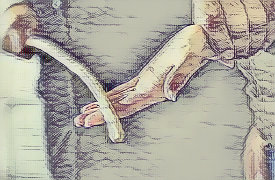
A typical crook-handled secondary school cane measured around 32 inches (81 cm) in length and approximately 10 mm in diameter. Manufactured from carefully selected lengths of rattan, each cane was chosen for its combination of strength, resilience, and flexibility. A well-made cane could bend considerably under pressure before springing back to its original shape without cracking or breaking. This natural elasticity was one of the reasons rattan became the preferred material for school canes over many decades.
The striking end was always carefully sanded smooth. This finishing process removed sharp fibres and rough edges, reducing the likelihood of the cane cutting or grazing the skin during use. A properly finished cane produced a clean, flexible stroke rather than the abrasive contact that an unfinished piece of rattan might create.
Durability and Maintenance
Contrary to some common assumptions, a quality rattan cane rarely split during normal use. Instead, with prolonged service, it was more likely to weaken or eventually snap close to the handle, particularly if the user employed a pronounced backswing before the downward stroke. This repeated flexing placed the greatest stress on the section held in the hand.
The familiar appearance of a cane becoming “hairy” or frayed at the tip was not normally the result of ordinary disciplinary use. Rather, this usually occurred when the cane had been struck repeatedly against hard surfaces such as floors, desks, walls, or other solid objects. Such misuse damaged the outer fibres of the rattan and significantly shortened the cane’s useful life. When excessive fraying, weakening, or breakage occurred, the cane would simply be replaced.
Because the effectiveness of the cane depended upon its flexibility and integrity, experienced staff generally avoided unnecessarily bending or flexing it for demonstration purposes. Excessive manual bending could damage the natural fibres within the stem and reduce both its lifespan and its performance.
How Crook-Handled Canes Were Made
The manufacture of traditional school canes was a surprisingly labour-intensive process. Unlike many modern products, they were almost entirely handmade, requiring skilled manual work at every stage. In both England, where the cane was used, and Scotland, where the tawse was the traditional instrument of corporal punishment, production relied on experienced craftsmen rather than machinery or automated manufacturing.
The distinctive crook handle was created by softening the rattan through soaking or steaming before bending it around a shaped former. The curved section was then securely tied into position and left to dry naturally. As the moisture evaporated, the fibres hardened and retained the required shape permanently.
This process was carried out in batches rather than individually. Manufacturers often secured twenty or thirty canes together along long poles or frames while the crooks dried, allowing many handles to be formed simultaneously. Although time-consuming by modern manufacturing standards, this method enabled consistent production while preserving the strength and resilience of the natural material.
Historical evidence from several major English manufacturers shows that this traditional tying and drying technique was standard practice throughout much of the industry’s existence. The finished products were remarkably consistent despite being made almost entirely by hand, reflecting the considerable skill of the craftsmen involved.
Researching the School Cane
Many of the details known today about school canes come not from personal experience alone but from careful historical research. Original manufacturers’ catalogues, surviving examples, period photographs, educational films, trade publications, and written descriptions of the manufacturing process all help to build a detailed picture of how these implements were produced and maintained.
Such sources demonstrate that while individual schools often had their own preferences regarding cane size or thickness, the underlying manufacturing methods remained remarkably consistent across much of England during the twentieth century.
A Memorable Teacher
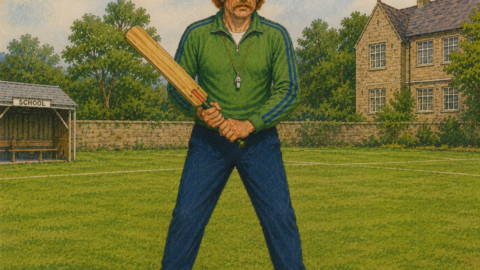
Like many schools of the era, ours had its share of memorable personalities. One teacher, affectionately known to pupils as Bertie, stood out for reasons entirely unrelated to discipline. Although he had been at the school for several years, he left after only one term of teaching our particular class.
Among the staff, Bertie was instantly recognisable because he drove a tiny bubble car, an unusual sight even at the time. These compact microcars attracted plenty of curiosity, but they were also famous for their cramped interiors and awkward access. Pupils often joked that getting into one seemed challenging enough, while climbing back out appeared even more difficult.
After Bertie left, various humorous stories circulated among former pupils about his departure, many centred on his distinctive little car. Like many schoolyard tales passed from one generation of pupils to the next, they became part of the folklore surrounding a teacher who, despite his brief time with our class, remained surprisingly memorable.