For much of the twentieth century, corporal punishment was an accepted part of everyday discipline in many Scottish schools. While the frequency and severity varied considerably from one school to another, one practice that many former pupils remembered was the “whole-class belting.” Rather than punishing only those directly responsible for an incident, some teachers disciplined every pupil in the classroom, regardless of individual guilt.
This collective form of punishment was most commonly used when a teacher briefly left the classroom. On returning, the teacher might hear loud talking, shouting, laughter, or find the room in obvious disorder. If no pupil admitted responsibility or identified those involved, the teacher sometimes decided that the entire class would share the consequences. The reasoning was simple: if the guilty would not come forward and the rest of the class chose to remain silent, then everyone would be held accountable.
Although this approach was widely accepted at the time, even many teachers privately recognised that it was rarely fair. It was highly unlikely that every child in the room had taken part in the disruption. Some pupils may have remained quietly in their seats throughout the incident, while others may have tried unsuccessfully to calm their classmates. Nevertheless, collective punishment was viewed by some members of staff as an effective way of reinforcing discipline and discouraging pupils from protecting those responsible.
How Whole-Class Beltings Were Carried Out
The procedure itself varied according to the teacher’s preferred method. In many classrooms, pupils were called to the front a row at a time. Each child would step forward, hold out their hands, receive the allotted number of strokes with the tawse, and quietly return to their seat. The next row would then follow until every member of the class had been punished.
Other teachers preferred a quicker approach. Instead of calling pupils forward, they walked between the rows of desks while pupils remained seated. Each child held out their hand as the teacher passed, receiving the prescribed strokes before the teacher moved on to the next desk. This method reduced disruption and enabled an experienced teacher to complete the punishment remarkably quickly.
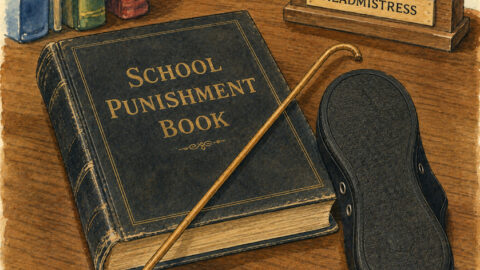
The implement almost universally used was the Lochgelly tawse, a heavy, split leather strap designed specifically for school discipline. The punishment was almost always administered across the outstretched palm or palms. One or two strokes were the most common penalty during a whole-class belting, although accounts from former pupils indicate that in more serious circumstances some teachers administered three or four strokes, and on rare occasions as many as six.
With class sizes commonly ranging between twenty and thirty-five pupils, carrying out such a punishment represented a significant task. Yet teachers who regularly used the tawse often became extremely proficient. If pupils cooperated by stepping forward promptly and presenting their hands without hesitation, a row of six children could be disciplined in well under a minute. Much of the time was actually spent moving pupils into position rather than delivering the strokes themselves.
More Than Just Classroom Noise
Although classroom disorder was the most common reason for a whole-class belting, it was far from the only one. Teachers sometimes resorted to collective punishment when they believed that the class had performed poorly as a group or had failed to meet expected standards.
Among the reasons recorded by former pupils were:
- Persistent talking or general disruption during lessons.
- Excessive noise while the teacher was temporarily absent.
- A refusal by those responsible for misconduct to admit their actions.
- Poor results in class tests that reflected badly on the teacher’s expectations.
- Failure by large numbers of pupils to bring textbooks, exercise books or completed homework.
- Unsatisfactory behaviour during assemblies or singing lessons, particularly when pupils failed to sing together or deliberately disrupted music classes.
- General laziness or lack of effort where the teacher believed the entire class shared responsibility.
In these situations, the punishment was intended not only to address the immediate problem but also to encourage pupils to police one another’s behaviour in future.
Maintaining Authority
To understand why some teachers relied upon collective punishment, it is necessary to appreciate the culture that existed within Scottish schools at the time. Classroom control was regarded as one of the defining qualities of an effective teacher. A teacher who regularly struggled with discipline risked damaging their professional reputation among colleagues and senior management.
Maintaining a quiet, orderly classroom was considered an essential part of good teaching. If a class became noisy whenever the teacher stepped outside for a few moments, it could be interpreted as evidence that the teacher lacked authority. For many teachers, allowing such behaviour to pass unchallenged was simply not an option.
A whole-class belting therefore served a broader purpose than merely punishing the immediate disturbance. It acted as a powerful demonstration that disorder would have swift consequences. Whether every pupil deserved the punishment was often regarded as secondary to restoring discipline and preventing similar incidents from occurring again.
In many schools this approach proved effective. After experiencing a collective punishment once, most classes became noticeably quieter whenever that teacher left the room. Pupils understood that if disorder broke out, everyone might once again share the consequences.
Of course, schoolchildren remained resourceful. In some particularly lively classes, pupils appointed an unofficial lookout near the classroom door. The lookout listened carefully for approaching footsteps and warned classmates that the teacher was returning, allowing conversations to cease and everyone to appear diligently occupied before the door opened.
Speed and Routine
Former pupils frequently commented on how efficiently experienced teachers carried out these punishments. There was little hesitation or discussion. Children knew exactly what was expected of them.
A well-practised teacher could discipline an entire class of thirty pupils in only a few minutes. Pupils came forward in silence, held out their hands, accepted the punishment, and returned to their desks rubbing their sore palms. The process became almost mechanical, with little interruption to the lesson.
Those who witnessed such events often recalled that the administration itself rarely lasted more than five minutes. The lesson then resumed as though nothing unusual had occurred.
The Attitude of Pupils
From a modern perspective, it can seem surprising that pupils generally complied so readily. Openly refusing punishment was extremely uncommon. During the period when corporal punishment was officially sanctioned, teachers possessed unquestioned legal authority to administer the tawse, and most children accepted that authority without protest.
Many pupils approached the front quietly when instructed, held out their hands, received the prescribed strokes, and returned to their seats with little outward display beyond the obvious discomfort of burning, stinging palms. Challenging the teacher’s decision, arguing about fairness, or refusing to cooperate was almost unheard of and would almost certainly have resulted in a more severe punishment.
This compliance reflected the educational culture of the period, in which respect for teachers and acceptance of school discipline were deeply ingrained. Whether pupils agreed with the punishment or believed it to be just was often considered irrelevant; obedience was expected, and most children complied without question.
Today, whole-class corporal punishment is widely regarded as both unjust and ineffective because it punished innocent pupils alongside the guilty. Nevertheless, it remains a significant aspect of Scotland’s educational history, illustrating the disciplinary methods that were once considered entirely normal in classrooms across the country.