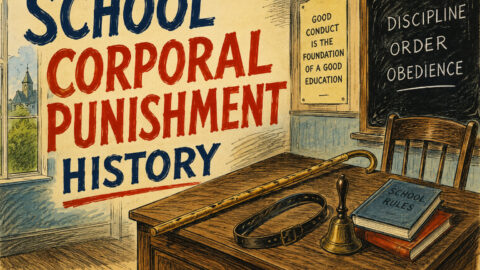
As more memories surfaced, one thing became increasingly clear. There was never a universal approach to corporal punishment in British schools. While some schools treated boys and girls in much the same way, others drew a clear distinction between the sexes. What happened to a child often depended less upon national policy than upon the individual philosophy of the headteacher and staff.
Some former pupils remembered schools where physical punishment was administered openly to both boys and girls. Others recalled that girls were almost never punished physically, while boys regularly faced the slipper or cane. The contrast between these experiences demonstrates just how varied school discipline could be across Britain.
One former pupil from South London remembered that, although children occasionally received a smack on the legs or bottom in primary school, public slipperings or canings were extremely rare. When the cane was used, it was generally administered privately by the headteacher or deputy head, usually across the hands and away from the classroom. In that particular school, privacy appeared to be considered an important part of maintaining discipline.
Elsewhere, however, memories were very different.
Some schools continued to administer punishments openly in front of classmates. A number of former pupils recalled girls being called to the front of the room alongside boys to receive strokes of the ruler across the hands for offences such as passing notes or persistent talking during lessons. These punishments were carried out calmly before the class, with little ceremony and no suggestion that girls should automatically be treated differently.
Other recollections came from private education.
One woman who attended an independent girls’ school during the early 1980s remembered that classroom discipline remained common throughout her secondary education. According to her account, several female teachers maintained strict standards, and pupils who repeatedly misbehaved could expect to be disciplined during lessons. Looking back, she remarked that few pupils regarded it as especially remarkable at the time. Only years later, as attitudes changed and discussions appeared online, did she realise how unusual such memories had become.
Not everyone accepted every recollection without question.
As often happens when people compare memories from many decades earlier, contributors sometimes challenged one another’s accounts. Some believed certain descriptions reflected only a handful of schools rather than the wider educational system. Others argued that their own experiences demonstrated entirely different practices. Rather than producing one definitive answer, these disagreements highlighted the remarkable diversity that once existed between schools.
Among the many recollections, one theme emerged repeatedly.
Teachers often developed their own personal approach to discipline.
Some believed punishment should be public, reinforcing authority before the whole class. Others preferred to deal with matters quietly in an office, preserving a pupil’s dignity while still maintaining order. Some rarely used corporal punishment at all, while others relied upon it frequently enough that pupils knew exactly what to expect if they crossed the line.
The result was that children attending schools only a few miles apart could leave with completely different memories of their education.
For some, seeing girls receive corporal punishment was entirely ordinary. For others, it almost never happened. Neither account was necessarily wrong. They simply reflected different schools, different teachers and different ideas about how discipline should be maintained.
As more former pupils added their recollections, another fascinating question began to emerge—not whether girls were punished physically, but whether boys and girls were treated equally when they broke exactly the same rules. That issue would become one of the most thought-provoking themes of all.