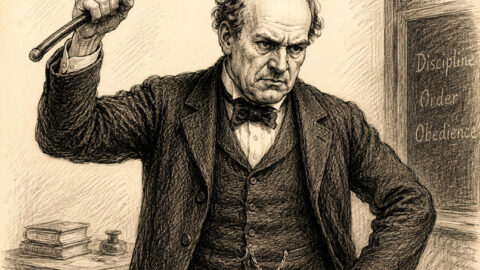
Schools themselves acquired reputations.
Parents, pupils and neighbouring schools might describe one establishment as strict and another as easy-going.
Such reputations could become self-reinforcing.
Arriving at a New School
A new pupil rarely arrived knowing nothing.
Older brothers and sisters might already have attended.
Friends could provide information.
Stories circulated about particular teachers and about what happened to pupils who broke the rules.
Thus a child could enter secondary school already expecting strict discipline.
The First Weeks
The early weeks were particularly important.
One grammar-school contributor received his first formal punishment during his third week at the school.
By that stage he was still learning the institution’s rules and personalities.
The experience undoubtedly provided a rapid education in how seriously repeated talking was treated.
Other pupils could learn the same lesson simply by observing what happened to him.
Strictness and Order
A school known for firm discipline might take pride in good order.
But the survey warns us against assuming that strictness always meant frequent punishment.
A school where authority was well established might need to punish comparatively few pupils.
Conversely, frequent punishment might indicate persistent disciplinary difficulties.
Numbers alone cannot settle the question.
Stories Grow in the Telling
School reputations were also vulnerable to exaggeration.
Children enjoy stories.
A severe teacher could quickly become legendary.
A punishment heard about second-hand might grow more dramatic each time it was repeated.
For this reason, firsthand evidence remains particularly valuable.
What pupils believed about a school is historically interesting, but it is not necessarily identical to what actually happened.
Parents and Reputation
Parents also formed opinions about schools.
Some deliberately chose establishments known for traditional discipline.
Others might object if they considered methods excessive.
The relationship between parental expectation and school policy could therefore influence the continuation of disciplinary traditions.
Reputation and Reality
The survey repeatedly demonstrates the need to distinguish reputation from evidence.
A teacher remembered as terrifying may have punished relatively few pupils.
A school described as strict may have relied mainly upon the threat of punishment.
Another school may have possessed a mild reputation while individual teachers used corporal punishment frequently.
The reputation of a school nevertheless mattered because pupils behaved according to what they believed might happen.
Discipline operated partly through rules and punishments.
It also operated through expectation.