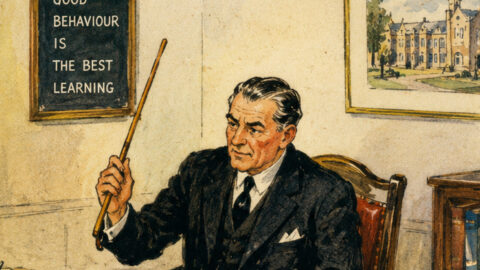
The great temptation when watching That’ll Teach ’Em is to decide that one educational era must be superior to another.
The programme itself makes that conclusion much more difficult.
The old-fashioned system possessed qualities which many people continue to admire.
Expectations were clear.
Teachers expected attention.
Academic knowledge mattered.
Competition was accepted.
Correct terminology and factual recall were treated seriously.
Practical science could be genuinely practical.
Pupils were expected to take responsibility for their conduct rather than regarding every rule as the opening position in a negotiation.
Yet the programme also revealed weaknesses.
Harsh words could be directed at pupils for failing to know material they had never previously been taught.
Children experiencing genuine distress might have received less emotional support in an actual 1950s institution than would be expected today.
Strictness could sometimes become an end in itself.
And some practices historically associated with school discipline quite properly belong to history rather than the modern classroom.
Modern education has different priorities.
Academic examination results remain important, but schools are also expected to develop confidence, cooperation, communication and social skills.
The modern workplace itself has changed.
Consequently, comparing a 1950s grammar school with a contemporary comprehensive is not quite like comparing two versions of the same machine.
They were designed partly for different societies.
That is what makes That’ll Teach ’Em more interesting than a simple exercise in nostalgia.
Its pupils arrived with modern expectations and modern habits.
The school confronted them with another educational philosophy.
Sometimes the pupils looked surprisingly ill-equipped.
Sometimes the supposedly superior old methods looked unnecessarily rigid.
And sometimes one could see perfectly sensible ideas sitting beneath the period uniforms and theatrical sternness.
Perhaps the most interesting lesson was that youngsters adapt remarkably quickly.
Rules which initially seemed extraordinary gradually became ordinary.
Uniform was worn.
Lessons were attended.
Detentions were endured.
Friendships developed.
The pupils began to understand what the staff expected from them.
That may be the most enduring lesson from this curious Channel 4 experiment.
The real argument is not whether Britain should recreate the schools of the 1950s.
It is which elements of older education were valuable, which were harmful, and which have simply become irrelevant to the world in which today’s children must live.
That’ll Teach ’Em did not provide an easy answer.
What it provided was something rather better: a fascinating opportunity to ask the question.