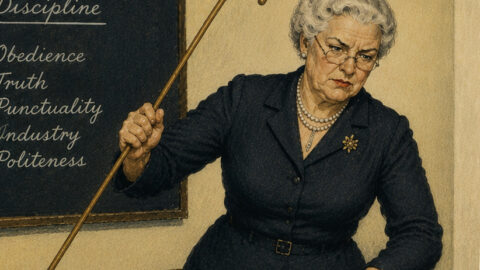
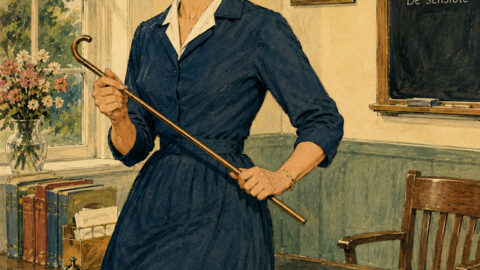
Looking back from the present day, it is tempting to imagine British school corporal punishment as a simple system.
The headmaster had a cane.
The PE teacher had a slipper.
Misbehaving pupils were sent along for punishment.
Reality was considerably messier.
Different schools, local authorities, headteachers and individual teachers developed their own customs. Even the same instrument could be used in completely different ways.
The cane might be given across the hands or buttocks.
The ruler could be applied to palms, knuckles or occasionally elsewhere.
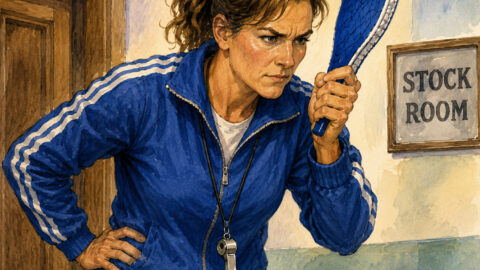
The plimsoll might be used across the bottom — or, as these recollections demonstrate, across an outstretched hand.
Gender complicated matters further.
Some schools punished boys and girls in essentially the same fashion. Others made clear distinctions. Female teachers sometimes punished boys; male teachers sometimes punished girls. In other establishments, strict conventions determined who could administer corporal punishment and to whom.
This variety is one reason why personal recollections are so valuable.
Official school punishment books, where they survive, can tell us that a pupil received “two strokes” for insolence or “four strokes” for fighting. They do not always explain precisely how the punishment was administered.
Former pupils remember the details that official records omitted.
They remember being told to hold out a hand.
They remember the rubber sole of a plimsoll.
They remember the stockroom.
They remember the teacher’s warning.
They remember moving their hand and being told to take the stroke again.
And decades afterwards, they remember the sting.
Of course, memories should always be treated with appropriate caution. Online recollections written thirty, forty or fifty years after an event are not the same as contemporary documentary evidence. Details become confused and stories can grow in the telling.
But when numerous independent recollections describe similar practices, they can reveal aspects of everyday school life that official histories sometimes overlook.
So what should we make of Mrs Shervington and the girls of Sir Wilfrid Martineau School?
She does not appear to have been unique.
Nor, however, does slippering girls across the hand appear to have been the standard British method of using the plimsoll.
The most familiar form of slippering remained punishment across the buttocks, particularly for boys. But there is enough anecdotal evidence to show that the palm was also used in some schools, by both male and female teachers and on both boys and girls.
It belongs to that enormous collection of local customs which made British schooling during the mid-twentieth century so varied.
Two people of exactly the same age could have attended schools only a few miles apart and emerged with completely different ideas about what constituted “normal” discipline.
One remembers the ruler.
Another remembers the cane.
Another remembers the slipper across gym shorts.
And somewhere else, a teacher simply opened a cupboard, produced an old plimsoll and said those familiar, ominous words:
“Hold out your hand.”