Corporal punishment of girls remains one of the more complicated parts of British school history.
Practices differed enormously from one school to another.
Some schools refused to use corporal punishment on girls altogether. Others permitted female teachers to use a ruler or slipper but not the cane. Elsewhere, girls could technically be caned, although such punishments might have been extremely rare and usually administered by a senior female teacher or the headmistress.
One person attending school in the late 1970s remembered that girls were never caned or slippered at their school. However, they heard about a girl attending a nearby mixed secondary school who had received the slipper from a female teacher.
Another contributor argued that the growth of mixed education during the 1960s and 1970s created an interesting dilemma.
As boys and girls increasingly attended the same schools, should they also face the same disciplinary rules?
Some schools decided they should.
Others continued to maintain different punishments according to sex.
There are certainly memories from women educated during the 1970s of being caned, slippered, strapped or struck with a ruler by female teachers and headmistresses, although experiences differed greatly according to school and region.
By the 1980s, however, corporal punishment generally was declining.
Attitudes towards the treatment of boys and girls were changing as well.
The severe punishments remembered from some earlier schools became increasingly difficult to justify. Parents were becoming more willing to challenge female teachers and headmistresses, teacher training was changing, and younger female staff frequently had very different ideas about discipline.
The transition was far from neat.
Old and new attitudes could exist side by side in the same staffroom.
One female teacher might regard the cane as an essential disciplinary tool.
The female teacher sitting beside her might refuse to use it altogether.
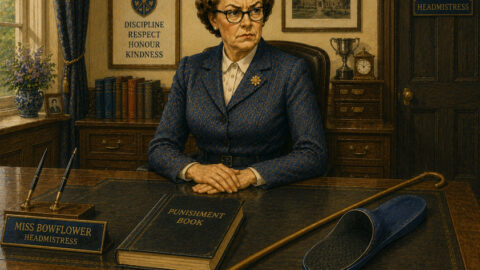
One school might have abandoned corporal punishment years earlier, while another a few miles away could still have a cane hanging in the headmistress’s office.
Private education complicated matters further because the 1987 abolition did not initially cover every independent school in the same way.
Even outside Britain, practices varied.
One contributor recalled hearing about two teenage girls at a mixed boarding school in Australia who were caned during the 1980s after being caught in the boys’ dormitory. In keeping with the female disciplinary staff described here, the punishment was administered by a senior female member of staff. Their parents were apparently informed by letter afterwards.
Interestingly, despite the school’s strict disciplinary system, their father said his daughters had been heavily involved in choosing the school and were extremely happy there, particularly enjoying its outdoor activities.
It is a useful reminder not to imagine one universal experience.
There was no single “1980s school.”
There were thousands of schools, each with its own traditions, female teachers, headmistresses, rules and attitudes.
For some pupils, corporal punishment was already something belonging to their parents’ generation.
For others, the cane, ruler or slipper in the hands of a female teacher or headmistress remained an uncomfortable reality.