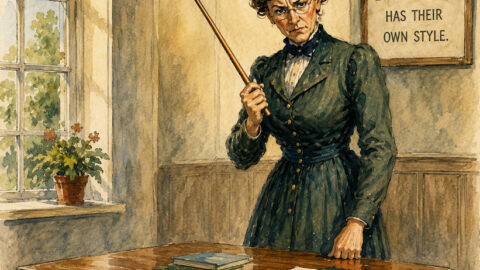
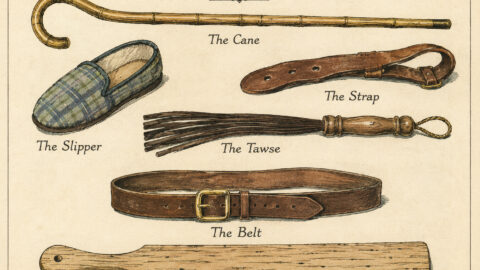
From the dunce’s corner and the “Welsh Not” to the cane, strict classroom rules and attempts to change left-handed children, the methods once employed to maintain order in schools now belong increasingly to another age. Yet memories of them remain remarkably strong.
There can be few subjects connected with old-fashioned schooling which arouse stronger memories than discipline.
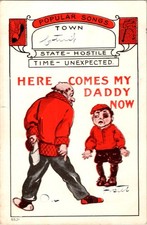
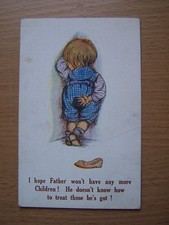
The dunce’s cap, so familiar from Victorian illustrations and children’s stories, appears almost comic to the modern eye. Yet public embarrassment was once regarded quite seriously as a means of correcting idleness, inattention or misbehaviour.
In Britain and America alike, generations of pupils knew what it meant to be made to stand conspicuously before their classmates. The actual pointed cap may have been less common than popular imagination suggests, but the principle behind it certainly survived.
One former pupil recalls being ordered by his teacher, Miss Edith Cartwright, to stand in the front corner of the classroom with his hands upon his head for ten minutes.
Another, Doreen Patterson, remembers a more curious punishment.
She was required to sit before the class with a waste-paper basket upon her head.
At a Canadian school, Miss Florence Green was remembered for what pupils called the “shame basket”. A large metal waste-paper bin stood beside her desk. A child considered troublesome might be ordered to stand inside it for the remainder of the lesson.
The supposed lesson was perfectly plain: the unfortunate pupil was being publicly represented as a “waste of space”.
Such methods depended upon embarrassment rather than physical discomfort. In their day they were sometimes considered mild alternatives to corporal punishment.
There were other forms of discipline which seem equally peculiar now.
One British pupil remembers a punishment known among the boys as “shorty punishment”. As a penalty for using the school library outside his allotted time, he was required to attend school in short trousers for six weeks.
The punishment may appear insignificant to adults today, but to a boy conscious of his classmates’ opinions it could be deeply embarrassing.
A particularly formidable primary teacher, Miss Winifred Barker, is remembered for another practice. She refused to permit pupils to leave lessons to visit the lavatory, however urgently they might ask.
Other teachers at the same school — among them Miss Margaret Collins, Miss Joan Bennett and Mrs Dorothy Clarke — were remembered as considerably more understanding and would generally excuse a child who raised a hand and asked permission.
Miss Barker was also regarded as a firm supporter of corporal punishment.
Such accounts illustrate an important difference between schools of earlier generations and those of today. Discipline was frequently left to the personal judgement of the individual teacher. Two classrooms separated by nothing more than a corridor might therefore be governed in entirely different ways.
The question naturally arises as to whether there is any modern equivalent of the dunce’s cap.
Probably very little survives in precisely the same form.
The increasing concern with a child’s dignity, combined with changing educational philosophy, has made deliberate public humiliation increasingly unpopular.
Yet the underlying problem confronting Miss Cartwright, Miss Green and their contemporaries has not disappeared.
Every generation of teachers must answer essentially the same question: how does one maintain order among a roomful of children without turning discipline itself into something unreasonable?
The answers given by earlier generations were very different from those now being considered.
And nowhere is that contrast more striking than in the long history of corporal punishment.