Recollections of School Discipline and Academic Standards in the 1960s
The methods by which schoolchildren are encouraged to apply themselves to their lessons have long been a matter of debate. In some schools, particularly during the present decade, failure through lack of effort may bring consequences extending considerably beyond a poor mark in the exercise book. The following recollections illustrate the considerable differences which exist from one establishment — and one teacher — to another.
There appears to be no universal rule concerning the punishment of pupils for poor academic work. In some schools it is regarded as quite improper to punish a child merely because she has failed to understand a lesson. Elsewhere, however, a distinction is drawn between inability and idleness.
One former grammar-school pupil recalls that this distinction was firmly observed at her school.
A girl who had genuinely tried but nevertheless produced poor work would ordinarily receive additional assistance. A girl considered capable of doing better, but who had failed through carelessness or insufficient effort, could expect considerably less sympathy.
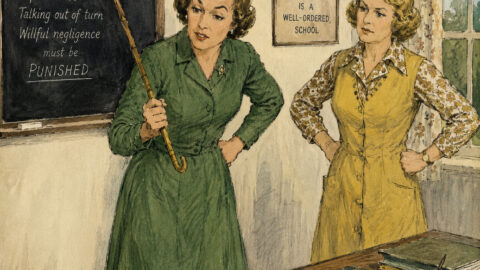
Miss Margaret Cartwright, a young science mistress, adopted a particularly straightforward system. She established what the girls came to call the “whack mark”.
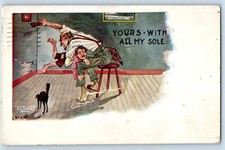
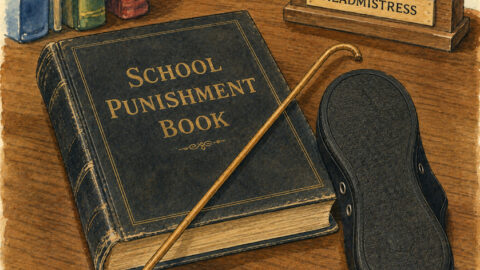
At the conclusion of a test, any pupil whose result fell upon or below this prescribed mark risked receiving the slipper.
There was, according to those who remember the practice, something remarkably matter-of-fact about the whole business. A test was given, the papers were marked, and the unfortunate pupils whose marks had fallen beneath the required standard knew what was likely to follow.
Whether such a system improved anyone’s understanding of science is another question.
History lessons at another school produced a similar arrangement.
During the first and second forms, Miss Dorothy Spencer conducted short oral tests for which the pupils wrote down their answers. These exercises eventually acquired their own familiar classroom saying:
“Last in the test gets six of the best.”
The phrase sounded more alarming than the reality apparently proved to be. Miss Spencer did not apply her rule with complete rigidity. If the lowest mark was nevertheless a respectable one — perhaps 75 per cent — punishment might be waived altogether. The same could happen when several girls shared the lowest position.
The slipper was used, although former pupils recall that the proceedings were conducted comparatively lightly.
Looking back, some regard the arrangement less as severe discipline than as one of those curious classroom customs which developed around individual teachers. Miss Spencer may simply have believed that introducing an unpleasant consequence for finishing last would encourage greater concentration.
Other schools took an entirely different view.
At one girls’ high school, where the cane was certainly no stranger during the 1960s, academic weakness was not considered an offence. The cane belonged to the sphere of conduct. It might be employed for disobedience, insolence, fighting, persistent talking or other breaches of school rules, but not merely because a pupil had obtained a disappointing examination result.
Such contrasting recollections demonstrate an important point about education in the present decade. There is no single description which can adequately represent “the 1960s school”.
Customs vary enormously.
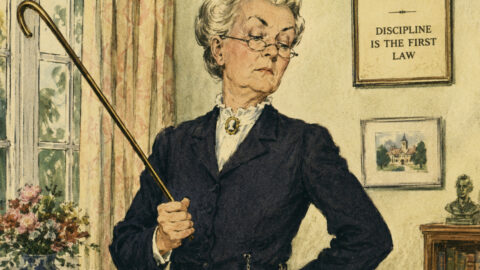
Much depends upon the school, its headmistress and, perhaps most importantly, the individual woman standing at the front of the classroom.