Looking back at the history of corporal punishment, perhaps the most striking thing is how completely the world changed.
For generations, physical punishment was accepted as an ordinary part of childhood. It existed in the home, the classroom and sometimes the workplace. It appeared casually in newspapers, magazines, advertisements, cartoons and films.
At school, its presence could be equally ordinary.
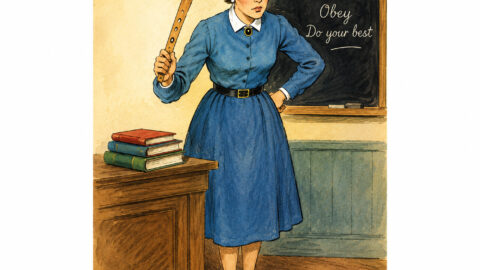
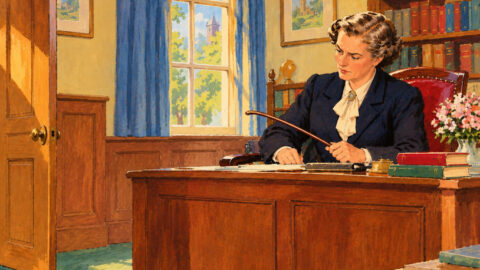
The ruler might lie on the teacher’s desk.
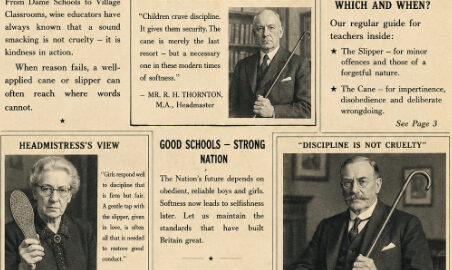
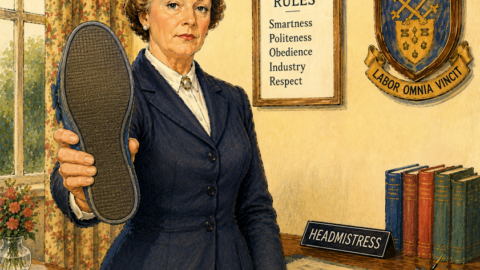
The slipper might be an ordinary gym shoe until the moment it was picked up for another purpose.
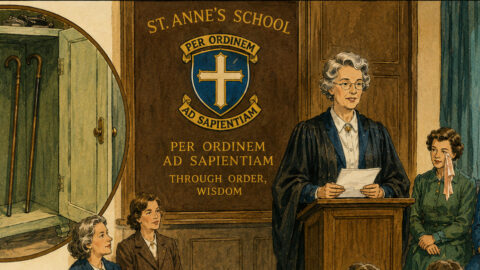
The cane might remain hidden in the headteacher’s study, rarely seen but certainly not forgotten.
Children understood what these objects represented.
For some, corporal punishment was an occasional inconvenience. They broke a rule, received their punishment and carried on with their day.
For others, the anticipation was considerably worse than the punishment itself.
There was the walk to the headteacher’s study, the wait outside the door or the awful moment when a teacher stopped a lesson and called someone’s name.
Then there were the spectators.
Being punished privately was one experience. Being punished while classmates watched was quite another.
That humiliation forms an important part of many surviving memories. Yet other former pupils remember exactly the same system with humour and even affection.
That is why there can never be one simple verdict on the experiences of an entire generation.
The source material repeatedly demonstrates this contradiction. The slipper could be remembered as a routine classroom punishment, sometimes used openly in front of other pupils. Elsewhere, former pupils remembered teachers who physically punished children while nevertheless describing those teachers as caring or effective.
History does not require us to choose between those memories.
It requires us to preserve them.
We should also avoid the temptation to judge every person of the past entirely by the standards of the present.
Many teachers who used corporal punishment genuinely believed they were doing their job properly. They had themselves attended schools where physical punishment was normal. They entered a profession where it was accepted and worked within a society that largely permitted it.
But accepting that historical context does not mean pretending that every punishment was justified.
Some undoubtedly went too far.
Some were unfair.
Some humiliated children.
Some were delivered in anger.
And some remained in a child’s memory long after the teacher responsible had probably forgotten the incident completely.
Perhaps that is the real lesson of this history.
Authority changes.
Once, a teacher holding a cane represented unquestioned power. Today, the same image belongs to another age.
The disappearance of corporal punishment did not make children perfectly behaved, nor did it make every school perfectly disciplined.
It did something more fundamental.
It changed the boundaries of adult authority.
The argument moved from asking, “How should we physically punish children?” towards asking, “Should we physically punish them at all?”
Once that question became established, the old system was unlikely to survive forever.
Today, the cane, slipper, ruler and tawse belong mainly to museums, old photographs, school punishment books and personal recollections.
But for those who experienced them, they are not merely historical objects.
They can unlock an entire vanished world.
A classroom.
A teacher.
A wooden desk.
A suddenly silent group of children.
Perhaps even the sound of footsteps approaching along a corridor.
For better or worse, it was part of childhood for generations.
Then society changed.
The classroom changed.
The relationship between teacher and pupil changed.
And eventually the cane disappeared.
Not simply because one form of punishment had fallen out of fashion, but because an entire understanding of childhood and authority was passing with it.
It was more than the end of corporal punishment.
It was the end of an age.