Memories of old-fashioned schooling produce sharply divided opinions.
One person remembers firm discipline with gratitude. Another remembers the same methods with resentment.
Perhaps that is inevitable.
No two pupils encountered precisely the same school, and no two teachers exercised authority in precisely the same manner.
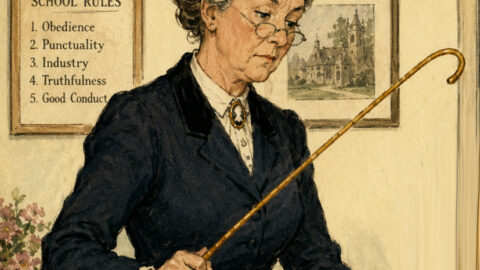
A teacher such as Miss Catherine Reynolds might maintain an orderly classroom through humour, fairness and quiet authority.
Another, Mrs Hilda Pierce, might depend heavily upon threats and punishment.
The rules might officially be identical, yet the experiences of their pupils could be completely different.
This distinction becomes particularly important when discussing children traditionally described as “difficult”.
A pupil who constantly challenged Miss Reynolds might prove perfectly manageable under Miss Joan Meredith.
Behaviour regarded in one classroom as deliberate insolence could sometimes arise from boredom, embarrassment, fear or simple misunderstanding.
An incident involving a girl called Sophie illustrates the point.
During an argument with Mrs Agnes Hardwick, Sophie said, “I understand.”
Mrs Hardwick immediately insisted that she did not and continued reprimanding her without allowing the girl to explain what she meant.
Whatever the rights and wrongs of the original disagreement, the teacher’s purpose should surely have been to resolve the difficulty.
Authority exercised merely to demonstrate that one possesses authority risks becoming self-defeating.
Good manners, after all, cannot convincingly be demanded from pupils by a teacher who does not display them herself.
None of this means that discipline is unnecessary.
The schoolmistress faces a task which outsiders occasionally underestimate.
Thirty or forty energetic children cannot simultaneously be allowed to behave exactly as they please. There must be rules concerning punctuality, courtesy, safety, work and the rights of others.
The question is how those rules should be enforced.
Past generations relied heavily upon fear, physical punishment and public embarrassment.
Some defenders of those methods argue that they produced resilient adults.
There is certainly truth in the observation that adult life does not always provide what one wants. A child must eventually learn patience, responsibility and consideration for others.
But severity alone cannot guarantee those qualities.
Britain’s great nineteenth-century schools were often extremely harsh. Their defenders once claimed such conditions prepared boys and girls for a demanding adult world.
Similar arguments were applied to the wider Empire: hardship supposedly produced toughness.
History permits a less comfortable interpretation.
Institutions which depend too heavily upon brutality can reproduce brutality.
Discipline certainly creates habits, but the nature of those habits depends upon the example being set.
A child may learn self-control.
She may equally learn that the strongest person is entitled to humiliate the weakest.
That is perhaps the most important lesson contained in these old schoolroom recollections.
The cane, the dunce’s corner, the waste-paper basket, the Welsh Not and the campaign against left-handedness did not all disappear at once.
Educational customs seldom do.
They faded as parents, teachers and society gradually began asking whether traditions survived because they were genuinely useful or simply because nobody had previously dared question them.
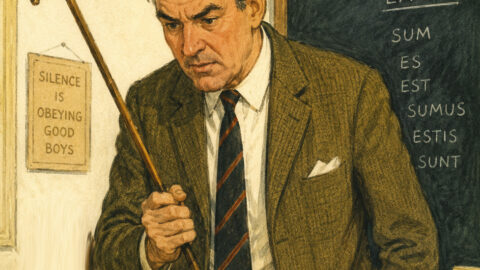
The modern schoolmistress — perhaps Miss Elizabeth Harper, standing before her class in 1966 — still has to maintain order.
She still encounters late pupils, chatterboxes, unfinished homework and the occasional determined rebel.
But increasingly she is expected to command rather than intimidate, to correct without humiliating and to understand as well as punish.
No doubt future generations will find some of our present educational practices equally curious.
That is one reason why the history of school discipline remains worth examining.
It tells us not merely how children once behaved.
It tells us how adults once believed children ought to be treated — and how profoundly those beliefs can change.