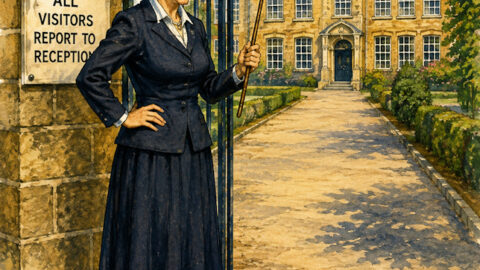
There are certain phrases which belong unmistakably to the British schoolroom of an earlier age: Report to the Headmaster, Hold out your hand, Bend over, and, most ominous of all, six of the best.
To generations of pupils, the number six possessed an almost mythical significance. It was generally understood to represent the severest ordinary corporal punishment that a school could impose without resorting to suspension or expulsion. Yet, like so many school traditions, the rule was far from universal. Some education authorities prescribed six strokes as a maximum; others permitted eight. Independent schools often followed their own customs, while individual headmasters interpreted the phrase according to temperament, tradition and technique.
The distinction between six strokes and six of the best was important. Six ordinary strokes might simply mean six brisk applications of the cane. Six of the best suggested something altogether more formal and formidable: deliberate strokes, carefully spaced and administered by a practised hand with the intention of leaving a lasting impression upon both memory and conduct.
In many schools, however, punishment was administered on a considerably smaller scale. Two strokes on the hand were common. A repeated offence might earn two on each hand. Three or four strokes were regarded as serious, while six remained the punishment spoken about in corridors but seldom witnessed.
One former pupil recalled that two strokes on the left hand were the usual penalty at his school. Persistent offenders received two on each palm, but he never knew anyone to receive the full six. The scarcity of the maximum punishment only increased its reputation. Boys discussed it in the playground in the same manner that soldiers might discuss some distant battlefield: with exaggeration, nervous humour and considerable relief that they themselves had not yet been sent there.
The threat alone could be effective. A boy who had received four strokes might be warned that the final one had been delivered with the force reserved for more serious cases.
“Come back again,” a master might say, “and it will be six like that.”
Such words could linger in the mind far longer than the immediate discomfort. The pupil was left to imagine the multiplication of that last stroke—the delay between each application, the effort required to present himself for the next, and the humiliating return to lessons afterwards.
The ceremonies surrounding punishment varied greatly. In some schools, the cane was kept in a cupboard and produced only when required. In others, it lay permanently upon the headmaster’s desk, an object of silent authority. Pupils summoned to the study found it impossible not to look at it.
One group of fifth-form boys remembered waiting outside their headmaster’s room after becoming involved in a collective misdemeanour. They stood in a line, listening for movement beyond the door and attempting, unsuccessfully, to appear unconcerned. Once admitted, they received a severe lecture while the cane remained conspicuously visible at one side of the desk.
They were then ordered to line up against the wall.
One by one, each boy was called forward, instructed to bend across the desk, and given six strokes. The waiting proved almost as difficult as the punishment itself. Those farther back in the line heard the swish of the cane, the impact and the headmaster’s instruction to remain in position. The third boy recalled trembling legs, a churning stomach and the uncomfortable knowledge that, at fifteen, he might not maintain the composure expected of an older schoolboy.
Yet after the long anticipation, the punishment itself seemed astonishingly brief. Within minutes all five boys had been dismissed. They retired to the lavatories near the craft block, where bravado gradually returned and the experience was examined, compared and converted into schoolboy legend.
At home, the customary parental judgement was delivered: they had brought it upon themselves.
Such was the moral climate of the period. The effectiveness, fairness and humanity of corporal punishment might be debated, but many parents regarded school discipline as the school’s affair. A pupil who complained of having been caned was often asked not what the teacher had done, but what he had done to deserve it.