By the autumn of 1958, quiet but unmistakable changes had begun to sweep through the corridors of St Bartholomew’s School.
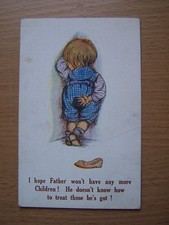
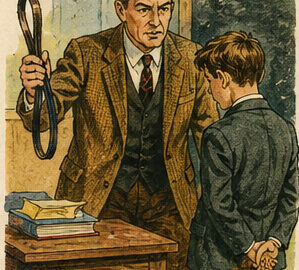
For decades the traditions of the school had remained largely untouched. Discipline had been clear, unquestioned and, in the eyes of most of the senior staff, entirely necessary. A boy who misbehaved expected consequences. A sharp word, an after-school detention, a visit to the Headmistress’s office, or, in more serious cases, the dreaded slipper or cane, had long been accepted as part of school life.
But a new generation of teachers had begun arriving from universities and teacher-training colleges with rather different ideas.
They had grown up during the war and entered the profession believing that education should shape character through understanding as much as authority.
Among them was Miss Eleanor Fenwick, whose thoughtful manner and patient approach had already earned the respect of many pupils.
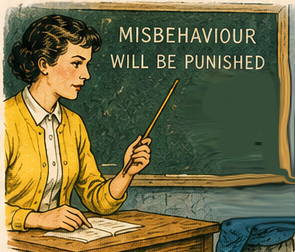
That same term she was joined by a lively young English mistress from London named Miss Susan Reed.
Miss Reed was unlike many of the older members of staff.
She encouraged discussion in her classroom.
She asked pupils for their opinions.
Rather than demanding silence at every opportunity, she believed that curiosity was often the beginning of learning.
Most surprising of all, she openly questioned whether corporal punishment achieved what it claimed.
Having previously taught in a progressive grammar school in London, she had watched countless boys receive canings or slipperings.
Some had improved.
Many had not.
Several simply became withdrawn, resentful or determined not to be caught the next time.
She often remarked to colleagues,
“A punishment may stop the behaviour for today, but surely we ought to ask ourselves why the behaviour began in the first place.”
Her comments caused raised eyebrows among the older staff.
One rainy lunchtime the conversation in the staffroom drifted, as it often did, towards discipline.
Mrs Bellamy, polishing her spectacles before returning them to the bridge of her nose, gave a faint sigh.
“I sometimes think modern teachers spend more time discussing children’s feelings than teaching them.”
A few members of staff chuckled quietly.
“In my day,” she continued, “we did not require a committee to discover why a child had thrown an ink bottle across the classroom.”
Miss Reed looked up from marking an essay.
“No,” she replied calmly. “You merely punished the throwing… and then waited for the next ink bottle.”
For several seconds nobody spoke.
Even the ticking of the large wall clock seemed unusually loud.
Mrs Bellamy stared over the rim of her teacup.
Miss Pritchard hid a smile behind her newspaper.
Mr Henderson, the mathematics master, quietly found something very interesting to study in his timetable.
No one quite knew how the conversation might continue.
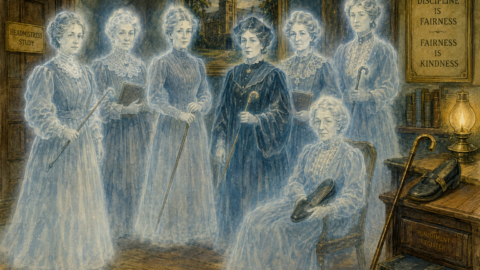
At the far end of the room sat Miss Beatrice Blyton, Headmistress of St Bartholomew’s.
She had listened to every word without interruption.
Her expression revealed nothing.
She had spent nearly thirty years maintaining discipline within the school and had seen generations of pupils pass beneath its stone archway.
She understood why older teachers believed firm punishment created order.
Yet she could not ignore the fact that education itself was changing.
Parents were beginning to ask questions that would once have been considered impertinent.
Educational journals increasingly spoke of encouragement rather than fear.
Inspectors expected records, explanations and accountability.
Society itself was slowly moving in a different direction.
At the following governors’ meeting Miss Blyton surprised almost everyone.
She announced that while she believed corporal punishment remained a legitimate disciplinary measure, its use would henceforth be governed by much stricter procedures.
“The cane and slipper,” she explained, “must never become instruments of convenience. They are to be used only after careful judgement and never through temper.”
The new regulations were detailed.
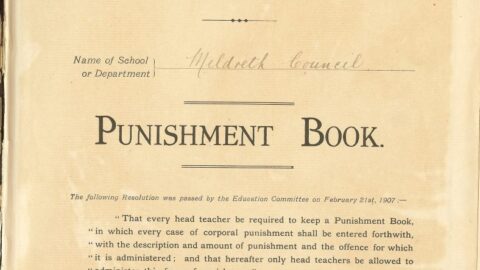
Every instance of corporal punishment was to be entered into a disciplinary ledger, recording the offence, the punishment given, the member of staff responsible and the date.
No teacher was ever to punish a pupil while angry or emotionally upset.
A second member of staff should, wherever practical, be present as a witness.
No child was ever to receive corporal punishment for poor academic performance, inability to understand lessons or genuine learning difficulties.
Any pupil who found himself repeatedly appearing in the punishment book would have his case reviewed personally by the Deputy Headmistress to determine whether deeper problems existed.
The announcement caused immediate discussion throughout the staff.
Traditionalists muttered that unnecessary bureaucracy had found its way into schools.
Mrs Bellamy declared that common sense had managed perfectly well for generations.
“Next,” she grumbled, “we shall require three signatures and a solicitor before confiscating a catapult.”
Others welcomed the reforms but argued they did not go nearly far enough.
Miss Reed privately remarked that recording punishments was certainly preferable to ignoring them, yet she hoped that one day schools might rely less upon fear altogether.
Neither side obtained everything it wanted.
Yet something subtle had begun to change.
As months passed, detentions gradually became the preferred response to minor misbehaviour.
Extra homework, written apologies and the temporary loss of privileges became increasingly common.
Pupils who repeatedly disrupted lessons were often required to help caretakers after school, tidy classrooms or spend evenings completing supervised study.
The familiar rubber-soled slipper remained in Mrs Bellamy’s office drawer, but it emerged less frequently than before.
The polished cane still rested in the locked cupboard of Miss Blyton’s study.
It had not disappeared.
It had simply become something reserved for the gravest breaches of discipline and only after considerable thought.
Many pupils noticed the difference.
The fear that had once lingered constantly around the school began, ever so gradually, to soften.
Respect increasingly replaced apprehension.
Teachers found themselves speaking with boys more often before deciding upon punishment rather than afterwards.
Miss Blyton herself seemed quietly transformed.
During assembly she spoke less about obedience and increasingly about personal responsibility.
One morning she addressed the assembled school beneath the carved crest that hung above the stage.
“A school,” she said in her measured, unmistakable voice, “must always have order. Without order there can be little learning.”
She paused, allowing the words to settle.
“But true order is not built solely upon punishment. It is built upon character, honesty, self-discipline and mutual respect. Punishment may correct an action, but only understanding can help shape the person who performed it.”
Many of the older pupils exchanged surprised glances.
It was not the sort of speech they would have expected from Miss Beatrice Blyton only a few years earlier.
The school had not abandoned its traditions.
The cane had not vanished.
The slipper had not been thrown away.
But the certainty that discipline could rely forever upon fear alone was beginning to fade.
A new chapter in the history of St Bartholomew’s had quietly begun.