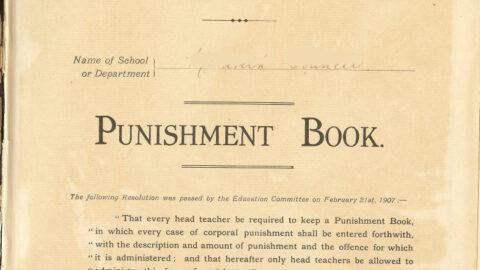
The headmaster’s study occupied a special place in school mythology.
Its furnishings were ordinarily respectable and dull: a broad desk, filing cabinets, shelves of prize-day volumes, a clock whose ticking seemed unnaturally loud, perhaps a portrait of the Queen or the school’s founder. Yet for a pupil awaiting punishment, each detail became unnervingly vivid.
One sixth-former remembered trying to memorise the titles on the top shelf while bent forward with his hands upon his knees. The exercise was intended to distract him. It did not work.
He had been implicated in the distribution of posters lampooning the headmaster. Although he denied producing them, he admitted knowing who had. Bound by the informal honour code of the school, he refused to give names.
Suspension was offered. He rejected it, fearing the mark it would leave upon his record, and requested the alternative punishment.
Under the school’s rules, that meant six of the best.
The headmaster appeared reluctant. A caning might turn the pupil into a martyr and lend importance to what was essentially a foolish protest. Nevertheless, the boy insisted.
The first four strokes were harder than he had anticipated. Between them came the strange interval characteristic of formal caning: enough time to recover one’s breath, but also enough time to understand that another stroke was approaching. He began to regret the gesture of defiance that had brought him there.
The final two seemed lighter, though whether the headmaster deliberately eased off or the pupil had simply become accustomed to the ordeal was impossible to say.
When it was finished, the boy stood, composed himself and shook the headmaster’s hand. The head praised him for taking the punishment well and dismissed him. Only after leaving the room did he allow himself to acknowledge its full effect.
Years later, he regarded the episode less as a triumph of courage than as an act of youthful vanity.
Other punishments carried less ambiguity. Theft, bullying and sustained dishonesty occupied a low position in the schoolboy moral order. Pupils who admired rebellion against unpopular rules could be merciless towards a thief or informer. A boy caned for smoking might receive sympathy. A boy caned for stealing from his classmates could find himself shunned long after the official punishment had ended.
One former pupil’s first severe caning followed the theft of money from the school library. Worse still, he had arranged matters so that another boy had previously been blamed and punished.
Earlier canings had been comparatively mild, leading him to believe that the cane was tolerable. His first encounter with a skilled and determined headmaster destroyed that illusion. When he protested that the punishment was too severe, he was informed that the headmaster knew precisely what he was doing. Continued argument brought an additional stroke.
The later punishment for theft was therefore delivered in the shadow of that warning.
It was followed by other serious disciplinary episodes: one after shoplifting, another after police attended the school to search his locker, and a final caning at the beginning of his last year. By then, his behaviour had improved, but minor offences continued. The headmaster announced that ordinary punishments had plainly failed. From that point onward, any breach of the rules would receive the maximum.
The pupil was never caned again.
Whether this represented successful reform, fear or simple maturity is open to interpretation. The threat certainly remained vivid. When tempted to break a rule, he remembered the study and chose otherwise.
Yet corporal punishment did not reliably reform everyone. Some boys accumulated strokes with remarkable frequency. Their classmates did not necessarily regard them as wicked; more often they seemed impulsive, unlucky or spectacularly poor at avoiding detection.
They might receive four strokes one week and two the next, returning to class with the air of seasoned campaigners. Their suffering perhaps accomplished little for them, but it served as a warning to others.
The punishment of one pupil was therefore intended for two audiences: the offender and the school community. Even a private caning became public knowledge. The recipient’s absence from class, the summons to the headmaster and his manner upon returning supplied all the necessary information.