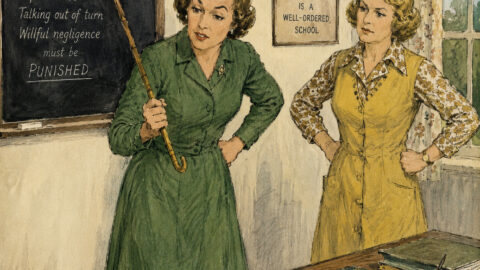
Corporal punishment has now been absent from ordinary British school life for long enough that an entire generation has grown up without experiencing it.
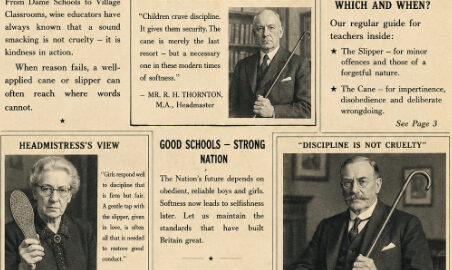
For younger people, the idea of a teacher reaching for a cane, slipper or ruler can seem almost unbelievable.
Yet there are still millions of people for whom it requires no imagination at all.
They remember it.
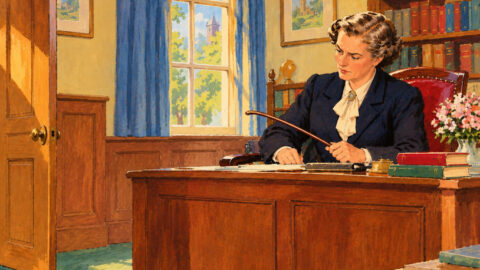
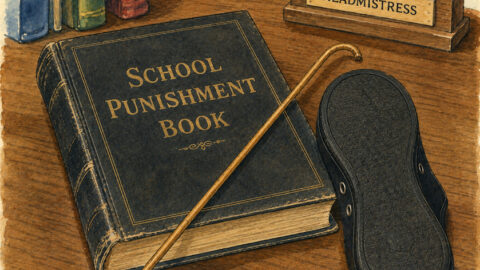
They remember the teacher who kept a ruler on the desk. They remember the gym shoe that suddenly became “the slipper” when used for punishment. Some remember being sent to the headteacher and wondering whether the cane would be waiting.
Others remember watching it happen to somebody else.
These memories are becoming an important form of social history because official records can tell us only so much.
A punishment book might record a pupil’s name, the offence and the number of strokes administered. It cannot tell us what the pupil thought while waiting outside the headteacher’s study.
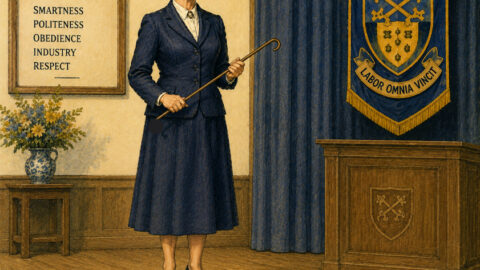
School regulations might explain which teachers were authorised to administer corporal punishment. They cannot recreate the silence of a classroom when someone was called to the front.
That history survives largely through memory.
And memory is complicated.
One former pupil may remember a teacher as terrifying while another remembers the same person with enormous affection.
The original material contains precisely this sort of contradiction. Teachers remembered as kind or caring could also be remembered for using physical punishment. One recollection describes a teacher as a “great believer” in physical discipline while simultaneously remembering her as a good teacher. Another recalls a teacher who created fear through the ruler but was nevertheless remembered as caring.
That tells us something important about the period.
People did not necessarily divide teachers into simple categories of kind teachers and cruel teachers.
Corporal punishment was so deeply embedded within the educational system that a teacher could genuinely care about pupils while also believing that physical punishment was an appropriate part of educating them.
The same complexity appears in the memories of former pupils.
Some speak about being caned or slippered with humour. The stories have become part of childhood folklore: the forgotten homework, the disastrous PE lesson, the prank that went wrong or the teacher who seemed able to produce a slipper from nowhere.
Other memories contain little humour.
For some, the strongest recollection is humiliation.
For others, it is injustice.
And for some, it is simply fear.
All of those voices deserve a place in the history.
There is a temptation when looking backwards to turn the past into something simpler than it actually was.
One side says:
“Children were better behaved because teachers could punish them.”
The other says:
“Corporal punishment was nothing more than cruelty.”
The lived experience was far more complicated.
There were reasonable teachers and unreasonable teachers. There were punishments considered fair even by the pupils receiving them, and punishments remembered decades later as completely unjust.
There were children who forgot the pain by teatime.
There were others who never forgot the humiliation.
That is why these recollections matter.
We are approaching the point where school corporal punishment will pass completely from living memory into documented history.
The classrooms remain.
The desks remain.
Some of the old school buildings remain.
But the world inside them has changed beyond recognition.
And eventually the last generation who remember hearing the words “You’re getting the cane” will themselves be gone.
When that happens, the cane and slipper will cease to be memories.
They will become history.