Perhaps the greatest difficulty with automatic punishment for poor marks was that examination results did not always tell the whole story.
One former pupil remembers this particularly clearly from her third-form physics lessons.
Physics was not her favourite subject. Indeed, she readily admits that she possessed little natural aptitude for it.
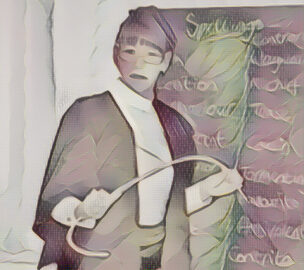
Her teacher, Miss Elizabeth Whitmore, announced that the class would be tested upon the work covered during the previous week. Any girl receiving less than 50 per cent, the class was informed, would receive the slipper.
Unfortunately, the pupil had spent the previous week at home with influenza.
She therefore entered the test knowing virtually nothing about the material upon which she was about to be examined.
When Miss Whitmore marked the papers, six girls had fallen below the required standard. They were instructed to remain behind at the conclusion of the final lesson of the day.
Four had attended the previous week’s lessons and were dealt with according to Miss Whitmore’s announced rule.
The remaining two had both been absent through illness.
Miss Whitmore instructed them to wait.
Then something rather unexpected happened.
Instead of immediately punishing them, the physics mistress sat the girls down and spent approximately a quarter of an hour explaining the material they had missed.
For a teacher whom the pupil had never particularly liked, this appeared surprisingly considerate.
The lesson was explained patiently, questions were answered, and for a few minutes the pupil began to revise her opinion of Miss Whitmore.
Then the tutorial ended.
The girls stood up.
Miss Whitmore calmly informed them that the original rule concerning the test result still applied.
The former pupil remembers being distinctly unimpressed by this interpretation of justice. Nevertheless, the punishment itself was recalled as considerably less dreadful than the anticipation of it.
There is, however, another story concerning Miss Whitmore which provides an interesting counterpoint.
She also taught chemistry.
During one practical lesson an experiment involving nitric acid went seriously wrong and some of the chemical splashed towards a pupil’s face.
Miss Whitmore reacted instantly.
Within moments she had pulled the girl towards the laboratory sink and placed her face beneath running water.
Whatever the pupils might have thought of their teacher’s disciplinary habits, nobody questioned her actions on that occasion. Those present later believed that her rapid response may have prevented a serious eye injury.
It is an instructive recollection.
School memories have a tendency to turn teachers into heroes or villains, saints or tyrants. Real people are seldom so conveniently arranged.
A mistress remembered for an apparently unreasonable punishment might, on another afternoon, demonstrate remarkable presence of mind when a pupil was in genuine danger.
The schoolchild naturally sees the teacher principally through the narrow window of classroom authority.
Only many years afterwards does the wider picture sometimes become visible.
Miss Whitmore remained unpopular with at least one pupil.
But she was never forgotten.