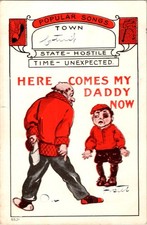
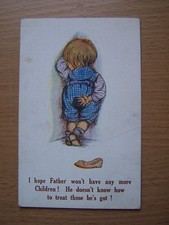
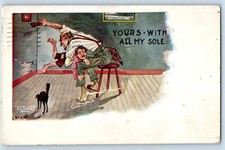
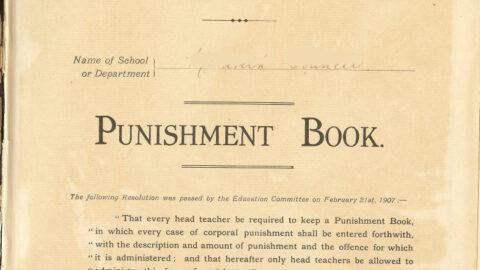
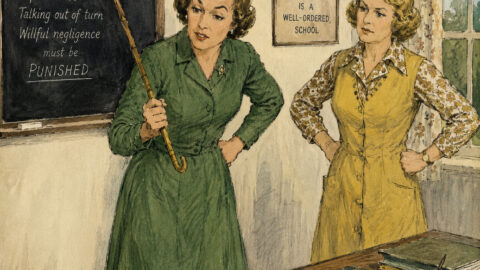
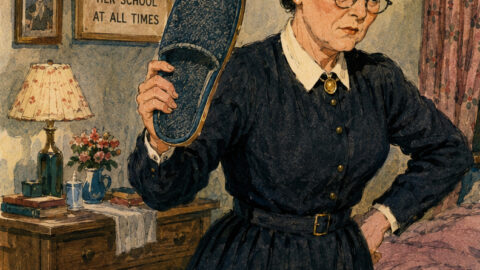
There was a time when one could mention the name of almost any English grammar school and, before long, the conversation would turn not to examination results or sporting triumphs, but to discipline. Ask a gathering of old boys to reminisce and it was remarkable how quickly they began recalling not classrooms or textbooks, but the masters whose reputations rested upon their readiness to administer corporal punishment. Long after Latin verbs and algebra had faded from memory, the identities of the “slippering masters” and the “cane men” remained crystal clear.
One former pupil, whose schooldays stretched from the closing years of the 1940s into the late 1950s, could still list a dozen or more members of staff who regularly resorted to the slipper or the cane. Considering there were only around sixty masters at the school, that represented a sizeable proportion of the teaching staff. In those days, corporal punishment was not regarded as an extraordinary measure. It formed part of the accepted machinery of school discipline, something boys expected to encounter sooner or later.
Yet another former pupil, entering the same school only a few years later, remembered a noticeably different atmosphere. Instead of a dozen habitual users of the slipper, he could think of barely half that number. By the time he left, even those familiar figures had begun to disappear. It was not that discipline itself had collapsed—far from it—but the willingness of ordinary classroom masters to settle minor misdemeanours with a quick slippering seemed to be ebbing away.
Looking back, it is tempting to imagine that the change happened suddenly, but memory suggests otherwise. Rather, it was a gradual retreat. One year an older master retired. Another quietly abandoned practices he had employed for decades. Younger teachers, fresh from university or National Service, often seemed less inclined to rely upon physical punishment as a routine classroom sanction. Without any formal announcement, the balance slowly shifted.
There remained, however, one conspicuous exception.
If any department seemed immune to changing fashions, it was Physical Education.
Across Britain, generations of schoolboys have painted much the same picture. The games master was expected to be firm, physically imposing and intolerant of idleness. Whether entirely deserved or not, PE departments acquired an almost legendary reputation for frequent slipperings. Untidy kit, lack of effort, talking in the changing room, lateness on the games field or apparent laziness during gymnastics could all result in swift punishment. Many old boys smile ruefully when recalling that the gymnasium seemed to possess its own code of discipline, one quite distinct from the rest of the school.
Perhaps this reflected the nature of games teaching itself. Physical exercise was associated with toughness, endurance and obedience. Masters who had served in the armed forces often carried those values into civilian life, believing that discipline was best reinforced immediately and unmistakably. A slippering delivered in the gymnasium was thought by many of them to settle matters quickly before the lesson continued.
Whether it actually improved behaviour remains open to debate.
The ordinary classroom presented a rather different picture. Here, punishments tended to be less frequent and often depended entirely upon the temperament of the individual master. Some scarcely touched the slipper at all, preferring extra work, detention or the writing of lines. Others regarded a couple of brisk strokes as infinitely more efficient than filling exercise books with repetitive sentences.
Most boys quickly learned which classrooms required particular caution.
“The history master’s all right.”
“Don’t answer back to old Jones.”
“Smith carries a slipper in his desk.”
Such observations circulated among pupils almost as unofficial survival guides. Every school possessed its own folklore concerning discipline, passed from older boys to younger ones with remarkable accuracy.
Significantly, in many boys’ grammar schools there was little question of girls entering this particular story, for the simple reason that they were absent altogether. Separate education meant separate traditions, and in the all-boys environment discipline became woven into the daily rhythm of school life in ways that now seem difficult to imagine. It was discussed matter-of-factly, complained about privately and joked about endlessly, but seldom regarded as unusual.
That is not to suggest boys welcomed it.
Few looked forward to receiving the slipper or the cane, and anticipation often proved worse than the punishment itself. A summons to remain behind after class, or to report to the headmaster’s study, could cast a shadow over an entire day. Lessons became difficult to concentrate upon. Friends offered sympathy, speculation or black humour. Rumours circulated concerning the likely severity of the impending interview.
Much depended upon the offence.
For everyday classroom indiscipline—persistent talking, failure to complete homework, insolence or repeated disruption—a classroom slippering might suffice. The matter would usually end there. Boys returned to their desks, lessons resumed, and the incident gradually disappeared into school memory.
The cane occupied an altogether different position.
It was invested with a formality that marked it out from lesser punishments. At many grammar schools, it remained firmly under the authority of the headmaster, deputy head or senior master. That exclusivity gave it symbolic importance. The cane was not merely another disciplinary tool; it represented the ultimate expression of school authority.
Unlike the classroom slippering, which might occur almost casually during the course of a lesson, a caning usually involved procedure. A boy was sent for. He waited outside the study. There might be a brief interview concerning the offence before sentence was pronounced. Even those who accepted the fairness of the punishment often remembered the atmosphere more vividly than the punishment itself: the polished desk, the silence of the corridor, the sense that one had crossed an invisible boundary from ordinary school life into something altogether more solemn.
Interestingly, recollections from the late 1950s reveal another change beginning to emerge. Older generations frequently spoke of boys being instructed to lower their trousers before receiving the cane, a practice regarded in some schools as entirely routine. By the early 1960s, however, many southern grammar schools appear to have abandoned it. Punishments increasingly took place over ordinary school clothing, preserving at least a degree of dignity that earlier generations had not always been afforded.
Why this alteration occurred is difficult to establish with certainty. Official records rarely concern themselves with such details. Yet oral history suggests that attitudes towards personal privacy and public embarrassment were beginning to evolve. Headmasters who saw themselves as modern educational leaders perhaps recognised that certain Victorian customs no longer sat comfortably alongside post-war Britain.
This was, after all, a period of profound social change.
Families were becoming more prosperous. University education expanded. Television carried new ideas into every home. Parents who had unquestioningly accepted severe discipline during the 1930s and 1940s increasingly found themselves asking whether such methods still belonged in a society that prided itself upon progress.
That questioning did not necessarily amount to opposition. Many parents continued to support firm discipline and expected schools to maintain high standards of behaviour. Yet there was a growing distinction between believing in discipline and believing that corporal punishment must always be its principal instrument.
One hears this distinction repeatedly in recollections from the period.
Older boys rarely argued that schools should become disorderly. On the contrary, many remembered their grammar schools with affection and respected the standards expected of them. What changed was not their attitude towards discipline itself, but towards the methods by which it was enforced.
Looking back from the perspective of the 1970s, it is tempting to divide history neatly into an age when corporal punishment flourished and another when it faded away. Reality was considerably more complicated. During the 1950s and early 1960s, the old system still functioned, yet subtle signs of retreat were already visible to those living through it. Some masters continued exactly as before; others quietly reached for different sanctions. The cane still hung in the headmaster’s study, but it was not always taken down as readily as it once had been.
At the time, few boys realised they were witnessing the beginning of a significant cultural shift. To them, each punishment seemed simply another episode in ordinary school life. Only years later, comparing memories across different generations and different schools, did the pattern become apparent. The slipper and the cane had once stood at the very heart of school discipline. By the early 1960s they were beginning, almost imperceptibly, to lose that central place.
The process was uneven, sometimes barely noticeable, and by no means universal. Yet it had begun—and it would gather momentum in ways that few masters, parents or pupils could yet foresee.