For many girls, the school day did not end when the final bell rang. Lessons might be over, but boarding life introduced an entirely new set of expectations. Once the classroom doors closed, another world of routines, responsibilities and discipline took over. The boarding houses were homes for much of the year, yet they were homes governed by rules that were every bit as strict as those found in the school itself.
The largest of these was Cedar Lodge, a handsome red-brick Victorian house standing beneath towering cedar trees that had watched generations of girls arrive with nervous smiles and heavy trunks. Cedar Lodge was supervised by Mrs Margaret Wetherby, a widowed housemistress whose calm authority had been shaped by years of service as a military nurse during the Second World War.
Mrs Wetherby possessed an extraordinary gift for organisation. Every blanket had its place. Every cupboard was expected to be neat. Every girl knew exactly what was required of her from the moment she awoke until the lights were extinguished each evening.
She was neither loud nor theatrical. There was rarely any need.
A single raised eyebrow from Mrs Wetherby could silence an entire dormitory.
Each morning began before sunrise with the ringing of the hand bell echoing through the corridors.
“Up, girls. The day has begun.”
Within minutes dozens of sleepy boarders would tumble from their beds, hurriedly dressing before beginning the morning routine that soon became second nature.
Beds had to be made with military precision. Sheets were pulled perfectly tight, blankets folded squarely at the foot of each bed and pillows carefully plumped. Shoes were polished until they shone and placed neatly beneath each locker. Uniforms were brushed, brushes and combs returned to drawers, washbasins left spotless and not a towel was to be found lying untidily across a chair.
Inspection followed breakfast.
Mrs Wetherby rarely needed to say much.
A poorly made bed might simply receive a quiet glance before she remarked,
“I believe you can improve that considerably before luncheon.”
Those few words were enough.
Girls quickly learned that disappointing Mrs Wetherby somehow felt worse than receiving a scolding.
Despite the regulations, boarding houses possessed a secret life entirely their own.
Once darkness settled across the school grounds and the corridors fell quiet, whispered conversations drifted between beds.
Torchlight flickered beneath blankets.
Comic books, detective novels and forbidden magazines were secretly exchanged beneath pillows.
Small tins of cocoa, homemade fudge and biscuits posted from home became treasures shared among trusted friends.
Every boarding house had its legendary midnight feast.
Someone always managed to smuggle a loaf of bread from the kitchens.
Someone else produced jam.
Another appeared with chocolate hidden inside a pillowcase.
The feast itself rarely lasted very long.
The laughter usually gave everyone away.
There were also illicit wireless sets hidden inside lockers, their volume turned almost to silence as girls attempted to listen to the latest music beneath the bedclothes.
The crackling voices of broadcasters floated quietly through the darkness until somebody inevitably hissed,
“Quick! She’s coming!”
Mrs Wetherby had perfected the art of moving silently.
She wore soft-soled shoes that produced almost no sound upon the polished wooden floors.
Many girls later swore she possessed supernatural powers.
Without warning she would appear at the end of the dormitory, hands calmly folded before her.
No footsteps.
No creaking floorboards.
Simply there.
One memorable evening she quietly drew back a blanket beneath which six girls had somehow squeezed themselves in order to continue a conversation long after lights-out.
She surveyed the remarkable scene with complete composure.
“Can anyone,” she asked gently, “explain why six perfectly sensible young ladies have chosen to occupy a bed designed for one?”
Silence.
After allowing the embarrassment to deepen for several seconds, she simply nodded.
“I thought not.”
The following morning every participant found herself assigned additional cleaning duties before breakfast.
Boarding punishments tended to be practical rather than dramatic.
Girls who repeatedly ignored the rules could expect to rise half an hour before everyone else.
Some lost their afternoon recreation.
Others scrubbed staircases, polished brass door handles, cleaned windows or helped tidy the dining hall after supper.
Writing lines also remained a familiar consequence.
“Consideration for others begins with obedience.”
“A boarding house depends upon cooperation.”
“Silence after lights-out exists for everyone’s comfort.”
Dozens, sometimes hundreds, of lines filled many exercise books.
Yet there remained one punishment reserved for more serious offences.
The well-known carpet slipper rested inside Mrs Wetherby’s office cupboard.
It was rarely seen.
Most girls went through their entire school careers without ever encountering it.
However, open defiance, repeated disobedience, deliberate dishonesty or dangerous practical jokes could result in its appearance.
The mere knowledge that it existed was often sufficient to restore order.
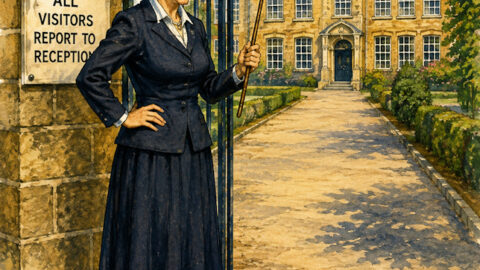
Across the school stood Hawthorn House, supervised by the formidable Miss Florence Dodd.
Where Mrs Wetherby relied upon quiet authority, Miss Dodd believed in unmistakable discipline.
She frequently reminded her boarders,
“When your parents entrust you to this school, they entrust us with your character as well as your education.”
Miss Dodd firmly believed that girls living away from home required clearer boundaries than day pupils.
Without mothers and fathers nearby, she felt the responsibility rested entirely upon the house staff.
Rules, therefore, were not optional.
They were essential.
Her famous carpet slipper quickly became part of school folklore.
New boarders heard stories about it within their first week.
Older girls claimed it possessed almost magical powers.
Whether those tales were exaggerated hardly mattered.
Its reputation travelled through every dormitory.
Miss Dodd possessed another remarkable ability.
She could detect whispered conversations after lights-out with astonishing accuracy.
Girls often joked that she could hear someone breathing from the opposite end of the corridor.
Many attempted to outwit her.
Very few succeeded.
Yet beneath her stern exterior lay genuine compassion.
When homesickness overwhelmed a new arrival, it was often Miss Dodd who quietly sat beside her bed long after everyone else had fallen asleep.
She listened patiently to worries about parents, younger brothers and sisters, family pets and familiar bedrooms left behind.
Sometimes she helped girls compose reassuring letters home.
Occasionally she wrote private notes to anxious parents herself.
Inside her office stood an old tin filled with barley sugar sweets.
These were never distributed casually.
A girl recovering from influenza…
Someone confined to bed with a heavy cold…
Or a particularly miserable youngster desperately missing home…
Each might quietly receive a single sweet together with a few encouraging words.
No fuss.
No display.
Simply kindness.
To modern eyes this mixture of firmness and affection may appear unusual.
Yet among many experienced housemistresses of the period it was perfectly natural.
They believed discipline created security.
Order created confidence.
Rules prepared children for adult life.
A girl might receive a stern punishment during the afternoon for breaking school regulations.
That very same evening the same mistress could sit beside her bed, straighten her blankets, check her temperature and make certain she had eaten her supper.
Neither action cancelled the other.
In the minds of women like Mrs Wetherby and Miss Beatrice Blyton, who oversaw the school itself with unwavering standards, discipline and care were never opposing ideas.
They were simply two equally important responsibilities entrusted to those charged with raising the next generation.
Whether history judges their methods kindly or critically, there can be little doubt that they believed they were shaping not merely educated young ladies, but resilient, responsible adults prepared for the world beyond the school gates.