The first lesson of a new school year was considered by many teachers to be the most important hour of the entire term. Long before a single exercise book had been opened or a line of homework had been set, opinions were already forming. Pupils judged their teachers, and teachers judged their pupils.
Among the staff there was endless discussion about the proper way to begin a new year.
Some believed that children should be welcomed with kindness, made to feel comfortable, and encouraged to settle gradually into their work. A cheerful smile, a few words of encouragement and perhaps even a light-hearted remark, they argued, created an atmosphere in which learning could flourish.
Others regarded such ideas as dangerously optimistic.
To them, the opening lesson was not a time for friendliness but for establishing order. Respect, they believed, had to be earned quickly and maintained constantly. Familiarity could come later, if it came at all. Until then, discipline would be the foundation upon which every successful lesson rested.
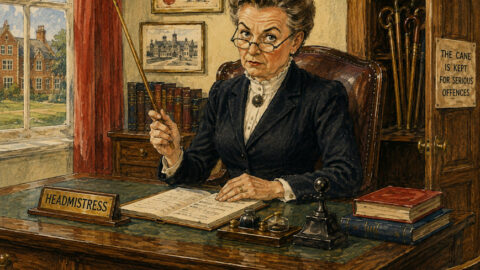
No one represented this philosophy more completely than Miss Beatrice Blyton, the formidable headmistress of St. Bartholomew’s.
Although she rarely taught ordinary classroom lessons herself, she made it perfectly clear to every member of staff that the tone of the school would be established during those opening hours of September.
At the annual staff meeting, held on the Friday before the pupils returned, she would remind her teachers in her calm but unmistakably firm voice,
“A school that begins untidily usually remains untidy. Expectations are established on the first morning. Set them high, and maintain them.”
Few teachers disagreed.
One who certainly did not was Miss Winifred Bellamy, the school’s respected mathematics mistress.
Miss Bellamy had taught generations of pupils. She possessed an orderly mind, immaculate handwriting and an almost supernatural ability to notice the smallest mistake on a page filled with calculations. Nothing escaped her attention—not an incorrectly ruled margin, not a forgotten date, not a poorly sharpened pencil.
On the first Monday morning of the autumn term, she could be seen striding purposefully along the polished corridor.
Beneath one arm rested a heavy pile of fresh exercise books, their covers crisp and unmarked.
In her other hand she carried a long wooden ruler, polished smooth through years of faithful service.
The chatter inside Form Three’s classroom was lively enough until the moment her footsteps became audible outside the door.
Conversation faltered.
A chair scraped hurriedly across the wooden floor.
Someone whispered, “She’s coming.”
The handle turned.
The room became almost silent before Miss Bellamy had even crossed the threshold.
Without acknowledging anyone, she walked directly to her desk.
The exercise books were placed down carefully in one neat pile.
Then, without warning, she lifted the ruler high and brought it down sharply upon the edge of the desk.
CRACK!
The sound echoed around the classroom like a rifle shot.
Several pupils jumped visibly.
One ink bottle rattled.
A boy who had been half-turning to speak to his neighbour froze instantly.
Within seconds every child sat perfectly upright with both hands resting upon the desk.
Miss Bellamy slowly surveyed the room over the rims of her steel-framed spectacles.
Her expression revealed neither anger nor pleasure.
Only expectation.
When she finally spoke, every word was measured.
“You will arrive punctually.”
A brief pause.
“You will bring every book and every piece of equipment required.”
Another pause.
“You will show every stage of your mathematical workings.”
She allowed her gaze to settle upon a nervous-looking boy in the third row before continuing.
“You will not whisper.”
“You will not fidget.”
“You will not copy.”
“You will not invent excuses.”
The silence that followed seemed almost tangible.
Then came her final question.
“Are there any questions?”
There never were.
Not on the first day.
Miss Bellamy often remarked in the staff room that a teacher who smiled too early spent the remainder of the year attempting to recover lost authority.
“It is infinitely easier,” she would observe while stirring her tea, “to become kinder than it is to become stricter.”
Several of her colleagues quietly agreed.
Others practised the same philosophy in different ways.
Mrs Edith Palmer, the geography mistress, delighted in beginning every September with an unexpected test.
No warning.
No revision.
Simply a sheet of questions placed face down upon every desk.
“It teaches preparedness,” she insisted.
Whether the pupils agreed was another matter entirely.
Miss Dorothy Crane, who taught French, believed appearance reflected character.
No lesson could begin until collars had been straightened, fingernails inspected, shoes examined, ties adjusted and blazers properly buttoned.
Only once she was satisfied that every pupil looked respectable would anyone be invited to sit.
She often reminded her classes, in carefully pronounced French,
“Discipline begins long before education.”
Meanwhile, in the Latin room at the end of the corridor, Miss Agnes Pritchard relied upon neither loud voices nor dramatic gestures.
She entered quietly.
She removed a fresh piece of chalk from its box.
Without speaking, she wrote four words across the blackboard in perfectly formed capital letters, each one large enough to be read from the furthest corner of the room.
SILENCE
ACCURACY
OBEDIENCE
EFFORT
She then placed the chalk upon the ledge and simply waited.
The effect was extraordinary.
The room settled itself.
Miss Pritchard rarely needed to raise her voice.
Indeed, many former pupils later admitted they could scarcely remember hearing her shout.
She possessed something far more effective.
A quiet certainty.
Everything she asked was expected to be done.
Everything she said mattered.
Inside the lowest drawer of her oak desk rested an elderly rubber-soled carpet slipper.
It was plain, brown, well worn and entirely unremarkable to look at.
Yet its reputation extended far beyond her own classroom.
Every pupil in St. Bartholomew’s seemed somehow to know it was there.
Very few had ever seen it.
Fewer still wished to.
Whether it was ever required was almost beside the point.
Its quiet presence served as a constant reminder that Miss Pritchard believed discipline was maintained not by frequent punishment but by the certainty that standards would always be upheld.
As for Miss Beatrice Blyton, she occasionally passed the classroom doors during those first lessons of September.
She seldom interrupted.
She merely paused for a moment in the corridor, listening.
If she heard only the gentle scratch of pens, the turning of pages and the calm voice of a teacher at work, she would allow herself the faintest suggestion of a smile before continuing on her rounds.
For Miss Blyton knew that the opening day of term was never simply about arithmetic, geography, French or Latin.
It was about establishing the habits that would shape the months ahead.
A quiet classroom was, in her eyes, not merely a peaceful one.
It was a classroom ready to learn.