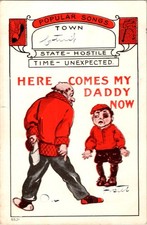
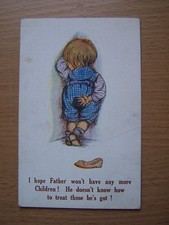
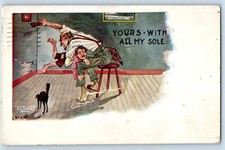
As the recollections continued, the conversation gradually moved beyond individual punishments and began exploring a much wider issue.
It was no longer simply a question of whether girls received corporal punishment.
The real question had become:
Should boys and girls be disciplined differently at all?
Former pupils held strongly differing opinions, many of which had remained unchanged for decades.
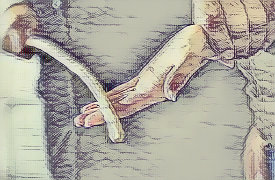
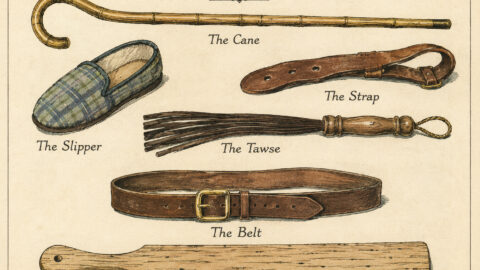
Several contributors remembered a time when boys and girls were treated very differently after breaking the same school rules. In some classrooms, a boy caught talking, fighting or failing to complete homework might expect the slipper or the cane, while a girl committing the identical offence received only a reprimand, extra work or detention.
For many boys, this created a lasting sense of injustice.
As children, they were not thinking about politics or educational theories.
They simply believed that if two pupils had broken the same rule, they should receive the same punishment.
One former pupil recalled that the boys in his class quickly realised that girls were no longer being sent for corporal punishment. No announcement had been made, but children notice these things. Before long, every boy understood that the rules had quietly changed.
Their reaction was immediate.
“That’s not fair.”
Interestingly, some former female pupils agreed.
One woman remembered attending a school where boys and girls were held to exactly the same standards. Looking back, she believed that equal expectations created equal responsibility. In her opinion, exempting girls from physical punishment while continuing to punish boys suggested that girls somehow required less discipline or were less accountable for their behaviour.
She argued that this ultimately disadvantaged everyone.
Not only did it create resentment among boys, but it also implied that girls could not be expected to meet the same standards of conduct.
To her, that was hardly equality.
Others, however, saw the issue very differently.
Some contributors argued that boys and girls matured differently and often responded better to different forms of discipline. They believed that treating everyone identically was not necessarily the same as treating everyone fairly.
According to this view, teachers should use whichever disciplinary methods worked best for each group, even if that meant boys and girls did not always receive identical punishments. This reflected educational thinking that became increasingly influential during the latter decades of the twentieth century.
The discussion gradually broadened into wider questions about education itself.
Should schools always apply exactly the same rules to everyone?
Or should they recognise that children are individuals who sometimes respond differently to the same methods?
Even today, there is no simple answer.
What is striking, however, is how thoughtfully many former pupils reflected upon their childhood experiences. Few were simply defending or condemning corporal punishment. Instead, they were using those memories to consider larger questions about justice, consistency and effective discipline.
Many contributors also recognised that attitudes had changed enormously since they were at school.
Practices that once seemed entirely ordinary would later become controversial.
Ideas about equality, children’s rights and acceptable discipline evolved rapidly during the closing decades of the twentieth century, leaving many former pupils looking back on a school system that had almost disappeared.
Yet despite these changing attitudes, one feature remained constant throughout the recollections.
Whether pupils approved of corporal punishment or opposed it, they almost always remembered the teachers themselves.
Some were remembered as strict but fair.
Others were recalled as unnecessarily harsh.
And a fortunate few were remembered as rarely needing to use punishment at all because their quiet authority alone was enough to maintain order.
In the end, it was often the teacher—not the cane, the slipper or the ruler—who left the deepest impression on the children sitting in those long-vanished classrooms.