The original question is particularly interesting because it concerned girls.
Was slippering across the hand more likely to be used when the pupil was female?
The surviving personal recollections are far too fragmentary to establish a firm statistical answer. Nevertheless, there are reasons why the practice may have appealed to teachers who were reluctant to slipper girls across the bottom.
Corporal punishment of girls has always been one of the more complicated areas of British educational history.
Practices differed enormously.
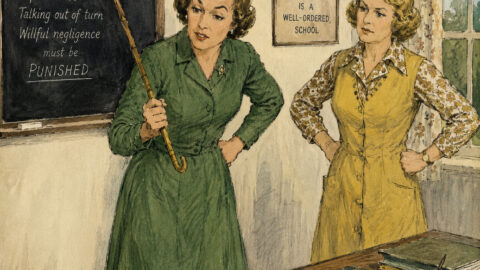
Some girls’ schools used the cane. Others used the slipper. Some preferred rulers across the hand. Some restricted physical punishment to younger girls, while others continued using it with teenagers.
In mixed schools, the situation could become even more complicated.
A punishment regarded as perfectly ordinary for a twelve-year-old boy might be considered embarrassing or inappropriate when administered to a twelve-year-old girl.
Individual teachers had their own views too.
A teacher might therefore decide that striking the palm was the simplest solution.
There was no requirement for the pupil to bend over, no awkwardness concerning skirts, and considerably less chance of the punishment being interpreted as humiliating.
There may also have been an assumption that punishment across the hand was somehow more respectable or restrained.
Whether the pupils themselves agreed is another matter.
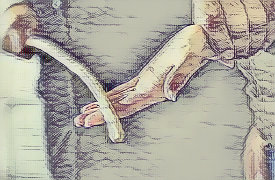
Several recollections specifically mention how much the punishment stung. A rubber-soled plimsoll brought sharply across an exposed palm could certainly produce an immediate sensation, particularly because the hand contains relatively little natural padding.
This also explains why moving the hand away was such an instinctive reaction.
Anyone who had experienced punishment with a ruler or cane across the palm would recognise the familiar problem: the pupil was expected to hold the hand perfectly still while watching the instrument descend towards it.
One contributor remembered doing precisely what generations of nervous pupils must have been tempted to do — moving the hand at the crucial moment.
Unfortunately, the teacher simply ordered the stroke to be taken again.
There is another possibility worth considering.
Teachers did not necessarily think deeply about the historical or educational logic of their chosen punishment. Sometimes they simply copied methods they had encountered elsewhere.
A young teacher entering a school might observe a senior colleague using a plimsoll across pupils’ hands and adopt the same method.
In this way, individual schools developed their own disciplinary customs.
The practice might continue for decades without anybody stopping to ask why.
This helps explain the peculiar geography of British school memories.
Ask former pupils from one school about a particular punishment and they may regard it as completely normal.
Ask pupils from a school five miles away and they may stare at you in disbelief.
That appears to be precisely what happened with slippering across the hand.
It was unusual enough to surprise many former pupils, but common enough for independent recollections to appear from Birmingham, Leeds and elsewhere.
The evidence therefore suggests something rather more interesting than simply “common” or “rare”.
It was a recognised practice — but very far from a universal one.