Authority in School Stories
Other novels carried the traditional disciplinary world still further.
In Tom Holland’s The Headmaster’s Son, Jack Cairn faces the particularly uncomfortable circumstance of being educated under his own father.
Rather than receiving preferential treatment, Jack finds himself regarded by the headmaster as a disappointment.
He is unpopular, bullied by other pupils and judged harshly.
After a confrontation with another boy, both pupils are punished publicly. Jack’s father assumes that his own son bears the greater responsibility and deals with him accordingly.
In the conventions of the story, however, this humiliating episode becomes a turning point.
With encouragement from a sympathetic form master, Jack begins to change his life and discovers an aptitude for football. Success eventually brings him the respect which had previously eluded him — including, most importantly, recognition from his father.
To the modern reader, the disciplinary assumptions may seem remarkable. Yet the broader story is an old and familiar one: the supposedly hopeless schoolboy who eventually proves his worth.
R. H. Ward’s The Offenders, dating from the early 1960s, presents another feature of traditional boarding-school life — disciplinary authority exercised not only by masters but also by senior pupils.
The novel includes a prefect punishing a bully before subsequently finding himself disciplined by a housemaster for his own conduct.
The details are considerably harsher than those found in many school stories and illustrate the formidable authority which fictional boarding schools could place in the hands of masters and prefects.
Again, fiction should not be mistaken for an official record of actual school practice.
Nevertheless, these stories reflect a society fascinated by questions of authority, character, obedience and punishment.
The headmaster was more than an administrator.
In the traditional school story he might be judge, moral guardian and final court of appeal.
The prefect occupied a lower but similarly significant position in the hierarchy.
By the 1970s these assumptions were increasingly being questioned.
Education was changing. So were relations between adults and children.
The unquestioned authority once granted to teachers was becoming the subject of public debate, and corporal punishment itself faced growing opposition.
Yet the old order had hardly disappeared.
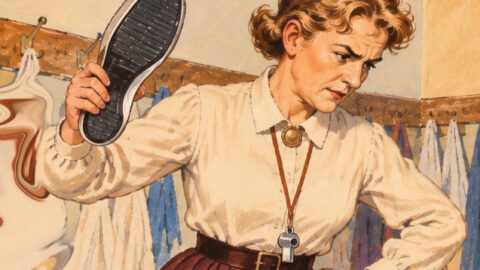
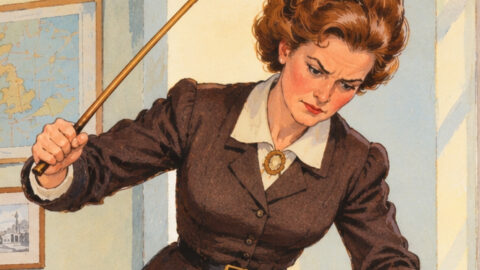
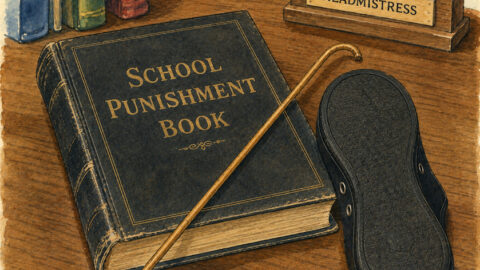
For many pupils attending school during the decade, the cane and slipper remained not relics from Victorian fiction but objects which could still be found in the headmaster’s study.