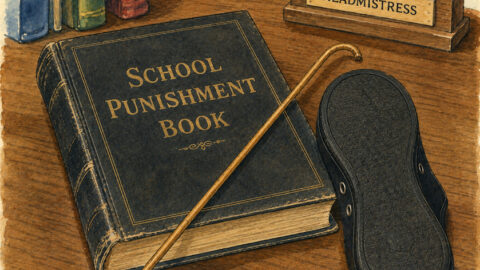
One of the clearest findings to emerge from this survey is that there was never one uniform system of corporal punishment.
Two children of the same age, living only a few miles apart, might attend schools with entirely different disciplinary customs.
At one school the cane might be reserved for serious offences and administered only by the headmaster. At another, several members of staff might be authorised to use it. Elsewhere the slipper might be the ordinary classroom punishment, with the cane appearing only occasionally.
This makes general statements about “school corporal punishment” difficult.
The Character of the School
The type of school could influence disciplinary practice, but even schools of the same type differed.
Grammar schools appear frequently in the recollections. So do private schools, church schools, boarding schools and ordinary secondary schools.
One grammar-school contributor recalled numerous formal canings between the ages of eleven and fifteen, beginning with three strokes for talking in class and later including punishments for running in a corridor, failure to complete homework, cheating, fighting and misbehaviour during assembly.
He also remembered numerous classroom slipperings which were not formally recorded.
His account is particularly revealing because it shows two disciplinary systems operating simultaneously.
There was the official system of formal caning, and alongside it the everyday system of classroom punishment.
A surviving punishment book might record the former while completely overlooking the latter.
A Strict School
Some schools acquired a reputation among their own pupils for being particularly strict.
This did not necessarily mean that every pupil was frequently punished.
Indeed, a strict disciplinary system might achieve its purpose precisely because most pupils wished to avoid its penalties.
The knowledge that boys were regularly waiting outside the headmaster’s office could itself influence behaviour.
At Oldfields Boys School in 1972, one thirteen-year-old remembered that there often appeared to be pupils waiting outside the head’s office for corporal punishment. He also recalled teachers using the slipper in classrooms.
His description suggests that physical punishment was not regarded as an extraordinary event at that school.
It formed part of ordinary disciplinary life.
The Boarding School
Boarding schools presented particular circumstances because the school exercised authority beyond classroom hours.
A day pupil normally escaped school discipline upon going home.
A boarder did not.
Dormitories, meals, evening study and recreation all remained under school supervision.
One contributor who attended boarding school recalled being caned at the age of fifteen for talking after lights-out. He stated that he was caned many times, particularly for dormitory offences, and did not consider the punishment effective.
This is significant.
The greater number of rules in a boarding establishment created a greater number of opportunities to break them.
The Teacher’s Discretion
Even within a single school, pupils could encounter very different disciplinary styles.
One teacher might overlook talking.
Another might issue a warning.
A third might immediately reach for the slipper.
The personality of the teacher was therefore almost as important as the written rules of the school.
This helps explain why former pupils so frequently remember individual teachers rather than regulations.
A rule book is impersonal.
The teacher standing at the front of the classroom was not.
No Typical School
It would consequently be misleading to construct an imaginary “typical British school” and suppose that its practices applied everywhere.
The survey points instead towards considerable local variation.
There were common features—the cane, slipper, headmaster’s study, punishment for fighting or persistent disobedience—but their application differed.
The central conclusion is therefore straightforward.
To ask, “How was corporal punishment used in British schools?” is too broad a question.
The more useful questions are:
In which school?
By which teacher?
For what offence?
And during which period?
Only when those questions are answered does the true pattern begin to appear.