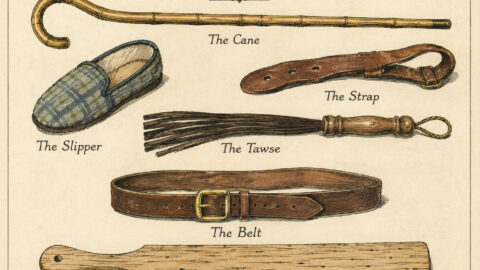
Corporal punishment was by no means confined to very young children.
The survey contains recollections from pupils in their early and middle teens, including boys of fifteen and sixteen.
This raises an interesting question.
Did corporal punishment lose its effectiveness as pupils became older?
The evidence provides no simple answer.
The Younger Child
For an eleven- or twelve-year-old arriving at secondary school, the threat of the cane could possess considerable authority.
Older pupils already knew the teachers and understood the school’s disciplinary customs.
The newcomer did not.
Stories heard from other children could therefore magnify the fear.
A first punishment might become an important event in the pupil’s school career.
One grammar-school boy recalled receiving three strokes from a senior mistress at the age of eleven for talking in class.
He considered the punishment effective and did not repeat the particular offence.
By the age of fifteen, however, the same pupil had accumulated several further canings for entirely different offences.
This demonstrates again the distinction between preventing one offence and producing general obedience.
The Teenage Pupil
Older pupils presented a different problem.
A fifteen- or sixteen-year-old was physically and emotionally very different from an eleven-year-old.
Teenagers were also increasingly conscious of their standing among friends.
Punishment could therefore involve questions of pride and embarrassment as well as physical discomfort.
A sixteen-year-old grammar-school boy recalled being slippered by a gym master for impertinence. He considered the punishment effective, although he believed he had deserved it only partly.
Another pupil of the same age was caned after being accused of cheating. Because he maintained his innocence, he regarded the punishment as entirely ineffective.
Age alone therefore tells us little.
The Sixth Form Question
As pupils approached the end of their school careers, the relationship between teacher and pupil inevitably changed.
Older teenagers might be given greater responsibility and freedom.
Some schools consequently reduced their use of corporal punishment with senior pupils.
Others continued it.
The survey does not contain sufficient systematic evidence to establish a general national rule.
That limitation is important.
A collection of recollections can demonstrate that something occurred; it cannot necessarily tell us how frequently it occurred throughout the country.
Pride and Independence
Adolescence also introduced a stronger desire for independence.
A younger pupil might accept punishment simply because a teacher possessed authority.
An older pupil might question whether that authority had been exercised fairly.
This may partly explain why accounts involving older pupils sometimes concentrate strongly upon whether the punishment was deserved.
The punishment was no longer merely something imposed by an adult.
It became something the pupil judged.
The End of Schooldays
For many former pupils, their last corporal punishment remained particularly memorable.
They knew, perhaps only afterwards, that they would never again stand outside a headmaster’s office or face the threat of the slipper.
School corporal punishment belonged to a particular stage of life.
The recollections collected here suggest that age changed its meaning.
To the younger child it could appear mysterious and frightening.
To the experienced teenager it was known territory.
That did not necessarily make it painless or welcome.
But the unknown had disappeared.