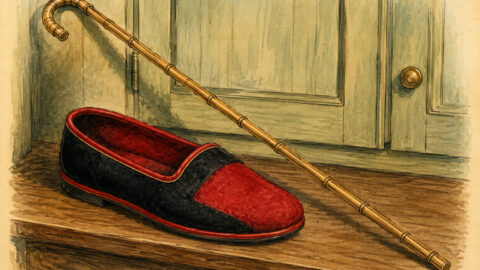
Perhaps the most important distinction in the survey is not between the cane and slipper, nor between boys and girls.
It is between punishments which pupils believed they deserved and punishments which they believed were unjust.
A surprisingly large number of contributors, looking back many years later, openly acknowledged that particular punishments were deserved.
They might dislike the memory while accepting the reason for it.
Others remained convinced that they had been punished unfairly.
The difference profoundly affected their judgement of whether corporal punishment had worked.
“I Deserved It”
Some contributors display remarkably little resentment.
A former pupil punished for serious misconduct described the punishment as severe but believed that his actions justified a serious response.
Others accepted punishment for talking, smoking, fighting or failing to complete work.
This does not prove that the punishment was objectively appropriate.
It tells us something different and historically valuable: the pupil accepted the school’s moral judgement.
In such cases the punishment reinforced a rule which the child already understood.
The Innocent Pupil
The situation changed completely where the pupil denied the offence.
The sixteen-year-old accused of cheating provides a clear example.
He maintained that another boy had copied his answers, rather than the reverse.
Neither the teacher nor headmaster believed him.
He was consequently punished for something he insisted he had not done.
Asked whether the punishment was effective, his answer was no.
This is hardly surprising.
A punishment cannot teach a pupil not to commit an offence which, in his own understanding, he never committed.
Instead it teaches another lesson: that authority can be mistaken.
Collective Punishment
Group punishment created similar difficulties.
One contributor recalled a classroom notice being deliberately damaged. When nobody admitted responsibility, a group of boys was caned.
One later confessed privately to the others.
The contributor therefore knew afterwards that he had been punished for another pupil’s actions.
Curiously, he did not remember remaining angry with either the headmaster or the guilty boy. He regarded the incident philosophically as bad luck.
Another child might have reacted very differently.
This illustrates the danger of drawing universal conclusions from individual testimony.
Severity and Justice
A severe punishment which a pupil believed deserved could sometimes produce less lasting resentment than a comparatively mild punishment believed unjust.
This may be one of the survey’s most significant observations.
Discipline depends partly upon legitimacy.
Children, like adults, possess a strong sense of fairness.
They may accept unpleasant consequences when they recognise the rule, understand the evidence and acknowledge their responsibility.
When those elements are absent, punishment can create resentment rather than obedience.
The Verdict Years Later
The survey has the unusual advantage of asking adults to reconsider punishments received during childhood.
Time has not produced one common verdict.
Some say:
“It did me no harm.”
Others say:
“It stopped me doing it again.”
Others remember embarrassment, fear or resentment.
Some believe a particular punishment was justified while condemning another punishment received at the same school.
This variety is important.
History becomes distorted when the past is forced into simple categories.
Corporal punishment was neither experienced uniformly nor remembered uniformly.
The pupil’s final verdict depended not only upon how much the punishment hurt, but upon a much more fundamental question:
Was it fair?