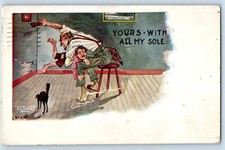
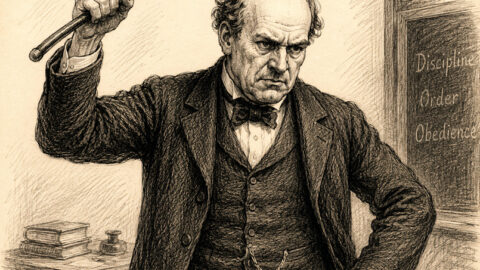
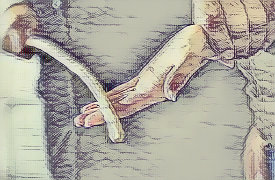
It’s worth noting that this comic contains 32 pages featuring 24 separate stories. Of those 24 strips, three include scenes of children receiving corporal punishment. Two involve teachers, which are shown here, while the third features a boy being punished by both his father and his Scout leader.
This wasn’t unusual for comics of the time. Having three stories in a single issue featuring corporal punishment gives a good indication of how common such scenes were in British children’s comics during that era.
The first strip is Whacky. Even the title is a reference to corporal punishment. Whacky regularly finds himself on the receiving end of punishment—sometimes because he deserves it, but often simply through bad luck. Dealing with these situations is a central theme of the strip.
The second strip is Teacher’s Pet. The main character, Patsy, desperately wants to please her teacher. Unfortunately, she often tries too hard. Her well-meaning actions usually create chaos, sometimes through her own mistakes and sometimes through circumstances beyond her control. On occasion, she pushes her teacher’s patience to breaking point.
This is a fascinating series, and I look forward to seeing more examples in print.
One interesting point concerns the publishers, D.C. Thomson, who also produced The Beano. Around six months ago, a professor of European Studies, who has a long-standing interest in media and culture, mentioned an article discussing the company’s editorial policies.
According to the article, during the 1950s, 60s and 70s, D.C. Thomson insisted that mischievous characters such as Dennis the Menace and Beryl always received their “just desserts.” The idea was simple: wrongdoing should never be rewarded.
Even more interesting was the company’s approach to marketing. Rather than targeting rough and rebellious children, the comics were intended as a moral influence. They offered readers a harmless escape, allowing them to enjoy fictional mischief while reinforcing the message that bad behaviour ultimately had consequences. This explains why the troublemakers almost always ended up being punished by the end of each story.
Ironically, many of the families who bought The Beano also encouraged their children to read more educational comics, such as The Eagle. Nevertheless, D.C. Thomson continued to follow this moral formula, which was thought to reflect the publishers’ strong Presbyterian background.
My friend also showed me a longer academic paper that explored many of these same themes in greater depth.
Although his main academic interests lie in political and cultural theory—particularly the work of Toni Negri and the Italian Autonomia movement—it was an interesting discussion. We studied together at university, so our conversations often wandered into unexpected subjects.
Dean, I also sympathise with your comments about copyright.
Many years ago, while I was an officer in the Student Union, we became involved in a dispute with the university over students’ rights to access their own files. The issue centred on secret comments and transparency. The disagreement eventually led to us occupying the Senate and Vice-Chancellor’s offices to make our point—and, naturally, to examine the files ourselves.
During the occupation, we produced a daily newsletter. As a joke, we used Dennis the Menace and Beryl as the masthead characters and included a couple of light-hearted cartoons poking fun at the university management. One cartoon ended with Dennis saying something like, “I wonder what Beryl will say… see tomorrow’s edition.”
Unfortunately, there never was a tomorrow’s edition featuring Beryl.
That very night, D.C. Thomson’s lawyers—no doubt tipped off by our rather combative Vice-Chancellor (who, I’m sorry to say, was Australian!)—served us with a cease-and-desist notice.
It seems someone at D.C. Thomson had very little sense of humour.