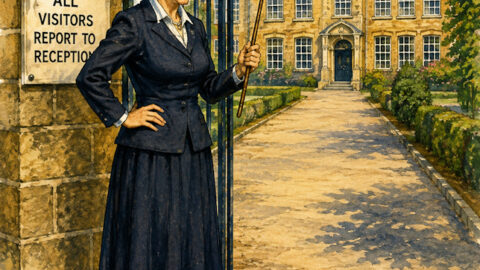
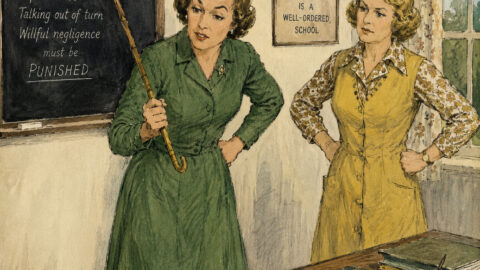
At St Anne’s School, discipline did not end when the final bell rang each afternoon. In the eyes of the staff, a pupil never truly stopped being a pupil simply because she had stepped through the school gates. Whether walking through the village, travelling home by train, shopping with her parents or waiting for a bus, every girl remained an ambassador for the school.
The navy-blue blazer, neatly pressed skirt and polished shoes were seen not merely as a uniform, but as a symbol of St Anne’s itself. Every pupil who wore them carried the reputation of the school upon her shoulders, and the staff expected behaviour that reflected the highest standards at all times.
It was an unwritten rule understood by everyone.
The school’s authority, many believed, extended far beyond its own buildings.
A girl caught smoking a cigarette at the railway station, laughing too loudly in the High Street, entering a public house, or behaving disrespectfully on public transport could expect to find herself standing before a teacher the very next morning.
The offence might have taken place miles from school.
The consequences would still arrive promptly.
St Anne’s enjoyed a close relationship with the surrounding village, and many local residents considered themselves unofficial guardians of its reputation. Shopkeepers, railway employees, church wardens and respectable townsfolk frequently kept watch over the pupils.
The school telephone rang surprisingly often.
Mrs Green, who owned the village bakery, once telephoned to report that two girls had pushed to the front of the lunchtime queue without waiting their turn. She was deeply offended by what she described as “most unladylike behaviour.”
On another occasion, the stationmaster informed the school that a boy from the neighbouring grammar school—and two St Anne’s girls who had been encouraging him—had climbed onto the railway footbridge railings while waiting for the afternoon train. Although no one had been injured, the incident was viewed as recklessly irresponsible.
Perhaps the most remarkable complaint arrived in the form of a neatly handwritten letter from a retired Army colonel.
He explained that three St Anne’s pupils had been laughing loudly outside the village post office while he had been collecting his pension.
“They displayed a complete lack of decorum expected of young ladies,” he concluded.
To modern readers, such complaints may seem trivial.
To the staff of St Anne’s, they were anything but.
Every report was investigated.
Every pupil involved was interviewed.
Every incident was entered into the discipline book.
The girls quickly learned that there was little point denying what had happened. The adults of the village seemed to know one another, and information travelled remarkably quickly. Before breakfast had even finished the following morning, the Headmistress often already knew exactly who had done what.
Miss Beatrice Blyton believed wholeheartedly that character was formed not only in classrooms but in everyday life.
She regarded every complaint as an opportunity to reinforce standards.
During one memorable assembly she stood beneath the school crest, her hands clasped behind her back, surveying the rows of silent pupils before speaking in her calm but unmistakably firm voice.
“Your conduct reflects upon St Anne’s,” she said.
“The uniform does not cease to matter merely because you have crossed the gates. Courtesy, honesty and dignity are habits, not costumes. They cannot be put on in the morning and removed at four o’clock.”
There was complete silence.
Even the younger girls sensed that no further explanation was required.
Yet the school’s influence stretched even further than behaviour in uniform.
Certain expectations continued regardless of what the pupils were wearing.
Smoking was strictly forbidden, whether dressed in school uniform or in ordinary clothes during the holidays.
Boarders were prohibited from visiting cafés, tea rooms or the local cinema unless they possessed written permission signed by the Headmistress or Housemistress.
Senior girls invited to birthday parties or family celebrations received firm reminders that alcohol was entirely inappropriate for St Anne’s pupils. Any reports of drinking—even away from school—could lead to suspension or, in more serious cases, expulsion.
Many parents supported these rules wholeheartedly.
They believed the school was helping to mould respectable young women who understood discipline, responsibility and self-control.
Some even welcomed the fact that teachers appeared to know what their daughters were doing before they themselves did.
Not every family agreed.
As Britain entered the late 1960s, society was changing.
Young people were becoming more independent.
Parents were beginning to question authority that previous generations had accepted without hesitation.
The pupils noticed the changes too.
One confident sixth-form student eventually challenged Miss Beatrice Blyton directly.
“Surely,” she said respectfully, “the school has no right to concern itself with what I do in my own parents’ home.”
A ripple of surprise passed through the classroom.
Few pupils had ever questioned school authority quite so openly.
Miss Beatrice Blyton paused for only a moment before replying.
“While you remain a pupil of this school,” she answered evenly, “your conduct remains our concern. Education does not finish at the classroom door, nor does good character.”
The discussion ended there.
Outwardly, at least.
But quietly, beneath the polished routines and long-established traditions, attitudes were beginning to shift.
The younger generation was growing up in a rapidly changing Britain. Television brought new ideas into every sitting room. Newspapers spoke of freedom, individual rights and personal choice. Universities questioned tradition. Popular culture encouraged young people to think for themselves rather than simply obey.
The unquestioned authority that schools such as St Anne’s had exercised for generations was beginning to weaken.
Few realised it at the time.
The rules remained.
The assemblies continued.
Letters from concerned villagers still arrived.
Miss Beatrice Blyton continued to uphold the standards she believed had served generations of pupils well.
Yet change was already waiting beyond the school gates.
The girls who once accepted every rule without question were beginning to ask why those rules existed at all.
The world outside St Anne’s was changing.
And, slowly but inevitably, the world inside the school would have to change with it.