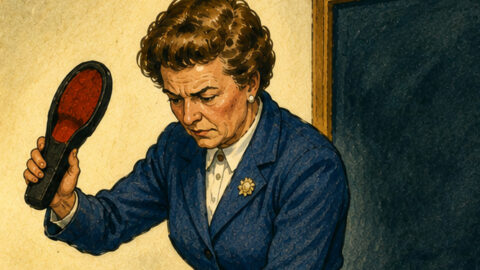
The number of strokes administered varied greatly.
There was no universal scale applicable to every school, and even within one establishment the number could depend upon the offence, the pupil’s previous record and the judgement of the teacher.
Nevertheless, certain patterns appear repeatedly in the accounts.
One, two or three strokes commonly represented the lower end of the scale.
Six strokes frequently represented a serious punishment and became sufficiently familiar to acquire the traditional expression “six of the best.”
Punishments exceeding six strokes certainly occurred, although the evidence suggests that they were less usual in British schools.
Three Strokes
Three strokes appear repeatedly in accounts of relatively ordinary offences.
An eleven-year-old boy who talked when ordered to work silently received three strokes of the slipper.
Another boy caught running in a corridor received three strokes of the cane from the deputy head.
A grammar-school pupil caned for “play fighting” on a staircase in 1959 similarly remembered receiving three strokes from the headmaster.
The latter regarded the punishment as effective. He did not repeat the particular offence, although it was not his last encounter with the cane.
Such examples illustrate an important distinction.
A punishment might successfully prevent one specific behaviour without transforming the pupil into a model of conduct generally.
Six of the Best
Six strokes represented a more formidable penalty.
Smoking, persistent disobedience, repeated failure to complete work and other serious offences appear among the reasons given for six-stroke punishments.
For pupils, the phrase itself carried significance.
“Six of the best” was widely understood without further explanation.
The punishment was intended to be memorable.
Nevertheless, the actual severity of six strokes could vary enormously.
A lightly administered caning from one teacher might be less severe than three vigorous strokes from another.
The instrument also mattered. Canes differed in length, thickness and flexibility. Slippers and straps likewise varied.
Counting strokes therefore provides only a rough measurement.
More Severe Punishments
The source also contains accounts of punishments involving eight strokes.
Such cases appear sufficiently unusual to have attracted comment from other contributors.
An eight-stroke caning was clearly towards the severe end of the British school scale.
One former pupil described receiving eight strokes following truancy and stealing. He considered the punishment completely effective and did not repeat the offence.
A sixteen-year-old girl reported receiving eight strokes in 1982 following a dispute with a teacher and refusal to attend detention. Her assessment was entirely different: she did not regard the punishment as effective and remembered both herself and her parents objecting to it.
These two cases provide a useful warning against assuming that severity automatically produces effectiveness.
Severity Cannot Be Measured by Number Alone
The survey therefore presents a problem for anyone attempting to construct a statistical table.
Numbers appear precise.
“Three strokes” seems easily comparable with “six strokes.”
In reality, the comparison is uncertain.
The force employed, the instrument, the location of the punishment, the clothing worn and the individual pupil’s physical and emotional response could all alter the experience.
The same nominal punishment might be administered quite differently by two teachers.
For this reason the number of strokes should be regarded as only one element in assessing severity.
A proper examination must consider the whole incident.