Looking back over the many recollections gathered together, one thing becomes immediately clear. There was never a single answer to the question that inspired so many discussions:
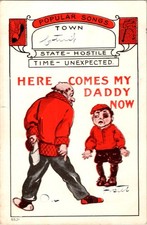
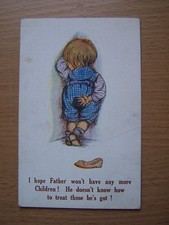
Which hurt more—the cane or the slipper?
Every person had their own answer.
For some, the cane was unquestionably the harsher punishment. The sharp crack of the rattan across the hands produced a pain unlike anything else they experienced at school. Even years later they could still remember the burning sensation across their fingers and the difficulty of writing for the remainder of the day.
Others believed the slipper deserved its fearsome reputation.
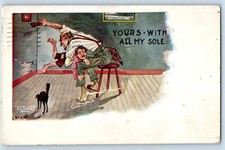
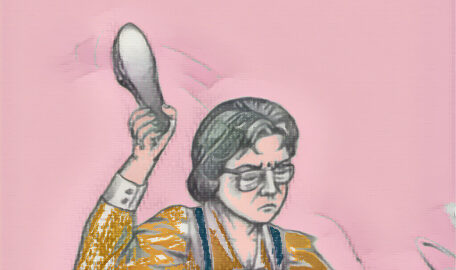
A determined teacher wielding a heavy gym shoe or carpet slipper could produce a punishment every bit as severe as many canings. Some pupils even preferred facing the cane, believing it was over more quickly than a prolonged slippering.
Then there were those who insisted neither implement mattered as much as the circumstances in which it was used.
Standing before an entire class while classmates watched in complete silence often proved more upsetting than the punishment itself. A private punishment in the Headmaster’s office might hurt just as much physically, but many found it easier to endure without the eyes of thirty other children upon them.
Embarrassment, they argued, often left deeper marks than pain.
One theme appeared again and again throughout these memories.
Children seldom compared punishments while they were at school.
At the time, they simply wanted to avoid them altogether.
It was only decades later, as adults looked back upon their childhoods, that comparisons began to emerge. They found themselves discussing details that had never seemed important as children—which teachers used the cane most skilfully, who preferred the slipper, whether male teachers punished differently from female teachers, or whether a ruler across the knuckles hurt more than a slap across the legs.
Memory has a remarkable way of preserving such details.
Some contributors could still describe classrooms that disappeared many decades ago.
Others remembered the exact appearance of the Headmaster’s office.
Many could picture the teacher involved as clearly as though they had left school only yesterday.
Yet surprisingly few spent much time describing the offences themselves.
Perhaps that is because the reasons now seem almost trivial.
Talking in class.
Late homework.
Running in the corridor.
Answering back.
Playing football after the bell.
Careless mistakes.
Small acts of childish mischief that, in another age, could result in corporal punishment.
Seen through modern eyes, many of those incidents appear remarkably ordinary.
That contrast reminds us just how greatly schools have changed.
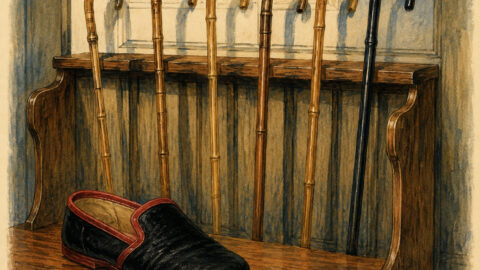
Today’s pupils would probably struggle to imagine classrooms where a polished cane stood in the corner of the Headteacher’s office, or where a gym shoe hanging behind a classroom door served not for games but for discipline.
To earlier generations, however, such sights were entirely unremarkable.
They formed part of the landscape of school life.
It would be wrong to imagine that every school was harsh or that every teacher regularly resorted to physical punishment.
The memories presented here suggest something rather more balanced.
Many former pupils spoke warmly of teachers who inspired them, encouraged them and helped shape their futures.
Even those who remembered severe punishments often spoke respectfully of the people who administered them, recognising that they were working within the accepted educational practices of their day.
Others remained critical, believing that some punishments crossed the line into unnecessary humiliation or excessive force.
Both viewpoints deserve to be heard.
History rarely offers simple conclusions.
Instead, it presents us with human experiences—sometimes uncomfortable, sometimes nostalgic and often deeply personal.
Perhaps that is why discussions about school discipline continue to attract interest long after corporal punishment disappeared from British classrooms.
These stories are not merely about canes, slippers or rulers.
They are about childhood.
They are about authority.
They are about growing up in a world that no longer exists.
For those who lived through that era, the memories remain surprisingly vivid.
The smell of polished wooden floors.
The scrape of chairs across classroom boards.
The ringing of the school bell.
The whispered conversations in the playground.
The nervous walk towards the Headteacher’s office.
These details survive because they belong to a formative period in people’s lives.
Whether remembered with amusement, regret, curiosity or discomfort, they have become part of Britain’s educational history.
Today, younger generations read such accounts almost as stories from another country.
School discipline has changed beyond recognition, reflecting wider changes in society’s understanding of childhood, education and the responsibilities of teachers.
The cane and the slipper have passed into history.
The memories, however, remain.
They remind us that every generation experiences school differently, and that what seems ordinary in one age may appear extraordinary in the next.
Perhaps that is the greatest lesson these recollections offer.
Not simply whether the cane hurt more than the slipper, but how rapidly society can change, transforming everyday experiences into history within the space of a single lifetime.
And so the debate continues—not because anyone expects a final answer, but because every memory adds another small piece to the story of Britain’s classrooms, preserving voices from a time when discipline was measured in polished wood, worn leather, and the unforgettable echoes of the old school bell.