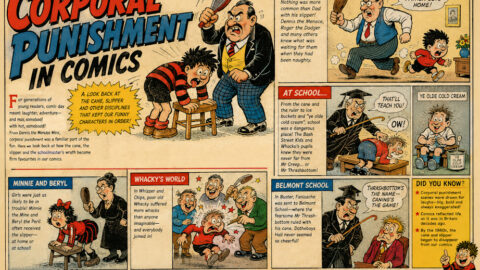
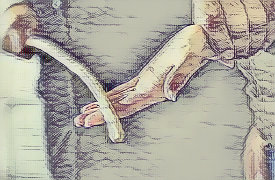
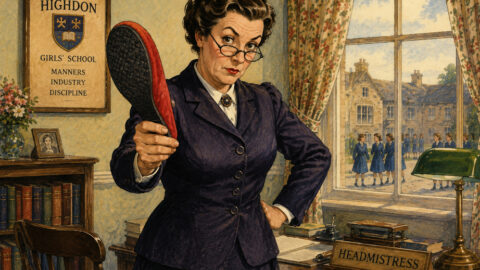
For much of the twentieth century, corporal punishment was deeply embedded in everyday school life across Scotland. The instrument most closely associated with Scottish education was the tawse—commonly known simply as “the belt”—a heavy strip of leather designed specifically for administering punishment. Unlike many other countries where different forms of corporal punishment existed side by side, the tawse became the universal disciplinary tool in Scottish schools, used across a wide range of offences and educational settings.
Contemporary accounts from former pupils and teachers alike suggest that the tawse was not an exceptional punishment reserved for the most serious acts of misconduct. Instead, it formed part of the daily rhythm of school life. In many schools, beltings occurred every day, and it was by no means unusual for a pupil to receive more than one punishment during the course of a single school day.
One reason for the apparent frequency of corporal punishment in Scotland is difficult to establish with certainty. Unlike some education authorities elsewhere, many Scottish schools were under no consistent obligation to maintain detailed records of every punishment administered. The absence of comprehensive documentation makes precise comparisons impossible. Whether Scottish schools genuinely punished more frequently than their English counterparts, or whether differences in record keeping have distorted the historical picture, remains open to debate. Nevertheless, surviving evidence, together with the recollections of thousands of former pupils, strongly suggests that the tawse was employed far more regularly than the English cane.
Different Systems of Discipline
Part of the explanation lies in the fundamentally different disciplinary systems that evolved north and south of the border.
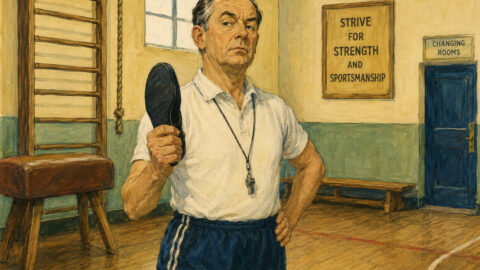
In England, schools often operated a two-tier approach to corporal punishment. Minor infringements of discipline were frequently dealt with using the slipper or gym shoe, while the cane was generally reserved for more serious offences or repeated misconduct. This distinction created an informal scale of punishments that allowed teachers to choose an instrument according to the severity of the offence.
Scottish schools, by contrast, relied almost exclusively upon the tawse. Rather than selecting between different implements, teachers varied the severity of the punishment by altering the number of strokes, the force with which they were delivered, or the type and weight of tawse used. A relatively light application might be given for talking in class or failing to complete homework, whereas repeated or more forceful strokes could accompany acts regarded as defiance, fighting, dishonesty, or persistent indiscipline.
The result was a system in which one implement served every disciplinary purpose, from minor classroom disruptions to the most serious breaches of school rules.
Measuring the Extent of Corporal Punishment
Because routine punishment records were rarely preserved, historians have relatively little statistical evidence showing just how frequently the tawse was used. The best surviving data comes from occasional academic surveys carried out by Scottish universities and educational researchers. These studies, conducted over limited periods, attempted to measure how often corporal punishment was being administered in schools at the time.
Although only snapshots rather than continuous records, such surveys consistently demonstrated that the belt remained an integral part of discipline throughout much of the twentieth century. They also revealed considerable variation between schools. Some headteachers regarded corporal punishment as an essential disciplinary tool and authorised its frequent use, while others encouraged staff to rely on it only when they believed no alternative would restore order.
Teachers and the Administration of Punishment
Contrary to the common stereotype that corporal punishment was almost exclusively administered by male teachers, the reality in Scotland was considerably more balanced.
In primary schools, where women formed the majority of the teaching profession, female teachers frequently administered the tawse as part of their normal disciplinary responsibilities. Male teachers were more commonly encountered in secondary schools and among senior staff, but they did not monopolise corporal punishment.
Overall, a reasonable historical estimate is that approximately 80 per cent of teachers who administered the tawse were women, reflecting the gender balance within primary education, while around 20 per cent were men, particularly in secondary schools and in positions such as deputy head or headteacher.
For pupils, the experience of being punished depended less upon the teacher’s gender than upon individual temperament. Some teachers rarely resorted to the tawse and preferred warnings or detention, while others developed reputations for using it readily and with considerable severity.
Discipline and Memory
Former pupils often recall school discipline through intensely personal memories rather than official records.
Many describe learning to anticipate the moods of particular teachers with remarkable accuracy. Children quickly became adept at reading expressions, tone of voice, or small behavioural changes that signalled whether discipline might be stricter on any given day. These observations, remembered decades later, are frequently recounted with a mixture of humour and unease.
One former pupil reflected that he learned more about adults’ changing moods from watching his teachers than he ever did from biology lessons. The changing expressions of those responsible for discipline became as familiar as the changing phases of the moon, and pupils often adjusted their own behaviour accordingly.
Seasonal memories are equally vivid. For many children, the school year was measured not by calendars but by nature itself. The appearance of crocuses and tulips signalled that summer holidays were approaching, while towering sunflowers reminded them that the return to school—and with it the possibility of renewed discipline—was drawing near. Sunrise, sunset, and the evening streetlights became markers that divided periods of freedom from the structured routines of school life.
Humour as a Way of Remembering
Recollections of corporal punishment are often accompanied by humour, sometimes dark and self-deprecating. Many former pupils use jokes to soften memories that were unpleasant or intimidating at the time.
Some laugh that seeking professional help later in life merely resulted in being told they were overthinking childhood experiences. Others joke that the people best suited to collecting unpaid debts were those who had once terrified schoolchildren. Such remarks are less intended as literal criticism than as examples of the wry humour with which many adults revisit difficult memories from their schooldays.
An Interesting Statistical Aside
An amusing comparison sometimes made when discussing school punishments involves the well-known “birthday paradox.”
At first glance it seems unlikely that two people in a small group would share the same birthday. Yet mathematics shows otherwise. Although any two individuals have only a 1 in 365 chance of sharing a birthday, the number of possible pairings increases rapidly as the group grows. With 23 people, there are enough possible combinations that the probability of two sharing a birthday exceeds 50 per cent.
The same principle illustrates how apparently unusual patterns can emerge naturally when many events occur over long periods. Clusters of punishments on particular dates, for example, may simply reflect statistical chance rather than any hidden cause.
Searching for Explanations
People have occasionally attempted to explain why punishments sometimes appeared unusually frequent on particular days of the month.
One tongue-in-cheek suggestion has been that teachers may have been in especially good spirits after payday, perhaps having enjoyed an evening out beforehand, making them either more relaxed or, conversely, more inclined to deal firmly with classroom misbehaviour. There is, however, no evidence to support such theories, and they remain part of the folklore surrounding school discipline rather than serious historical explanation.
In reality, fluctuations in punishment were probably influenced far more by factors such as examination periods, seasonal behaviour, staffing levels, or simple coincidence.
Names and Coincidences
Schoolchildren have always delighted in finding amusing coincidences. Some pupils wondered whether anyone named “Cane” had ever become a famous headmaster simply because the surname seemed so appropriate for someone associated with school discipline. Similar jokes arose whenever public figures happened to bear names such as Slipper or Belt.
Such observations reveal the playful curiosity of children, who often found humour even within institutions that they otherwise regarded with apprehension.
Catholic Schools and Discipline
Corporal punishment was by no means confined to state schools. Many Catholic schools also maintained strict disciplinary traditions throughout much of the twentieth century.
Former pupils frequently recall colourful personalities among the religious sisters who taught them. Memories of stern discipline, sharp wit, and uncompromising classroom control have become a familiar feature of autobiographical accounts. Looking back, many adults acknowledge that they understood very little about adolescence or human biology at the time, despite having access to encyclopaedias and reference books that occasionally contained surprisingly detailed historical discussions of corporal punishment, flagellation, and educational discipline.
School libraries sometimes restricted access to older historical works dealing with such subjects. Whether this reflected concern over mature content, the rarity of the books, or simply standard library practice remains uncertain. For curious pupils, however, locked cabinets only made the contents seem more mysterious.
Punishment Record Books
Where punishment records were maintained, schools often relied upon specially printed punishment books.
Examples surviving from Australia illustrate a pattern familiar throughout many education systems. Some were imported directly from Britain, while others were produced by government printers under contract for state education departments. Independent and Catholic schools commonly purchased the same official stationery, creating a remarkable degree of uniformity in how punishments were recorded across different sectors.
Although many such books have survived in archives and private collections, they represent only a fraction of the punishments actually administered. In countless schools, no permanent records were kept at all, leaving historians to reconstruct the everyday reality of corporal punishment through surviving documents, official inquiries, and the memories of those who experienced it firsthand.wed to purchase from the government printer as well.