The abolition of corporal punishment in Britain’s state education system brought an end not only to the practice itself but also to the official record books that documented its use. Once corporal punishment was phased out, there was little reason for local education authorities to continue printing specialised punishment registers, although administrative routines often have a habit of lingering long after policies change.
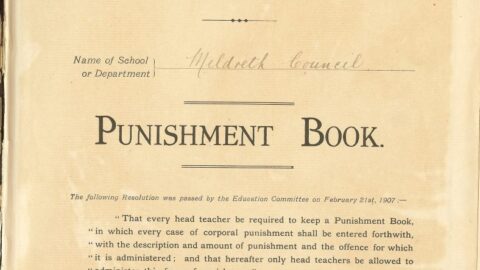
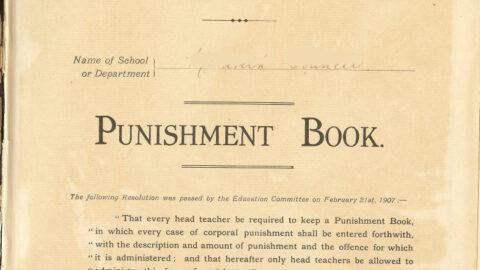
These surviving registers provide an unusually detailed glimpse into the day-to-day operation of schools during the first half of the twentieth century. Far from being sensational, many of them reveal how carefully regulated corporal punishment often was, with teachers required to record every incident, the reason for the punishment, the number of strokes administered, and sometimes even the instrument used.
Recording Corporal Punishment
One particularly interesting practice can be found in schools in Victoria, Australia, where some schools—especially Catholic schools—recorded corporal punishment not in dedicated punishment books but in the school’s Accident Book. These registers were originally intended to document injuries sustained by pupils while at school.
Why punishments were entered alongside accidents remains uncertain. It may simply have been more convenient to maintain one official register rather than two separate books. Alternatively, it may have reflected an administrative culture that regarded corporal punishment as another routine school occurrence requiring documentation. Whatever the reason, these records now provide historians with an unusual perspective on how discipline was managed.
An Unexpected Birmingham Collection
Over the years I have repeatedly encountered punishment records originating from Birmingham schools. Quite by coincidence, another register eventually came into my possession, covering the years 1932 to 1951.
Unfortunately, the school’s name was not identified, although the records clearly indicate that it was an ordinary mixed (co-educational) primary school operating under the Birmingham education authority.
The register spans nineteen academic years and contains exactly 50 recorded punishments involving 50 different pupils. Remarkably, no pupil appears twice in the register, meaning there was no repeat offending recorded during the surviving sample.
To preserve privacy, all pupil names have been removed and replaced simply with “boy” or “girl.” This follows the long-standing archival practice of withholding identifiable pupil information for one hundred years after the records were created.
The Nature of the Punishments
Every recorded punishment involved caning on the hands. No other method of corporal punishment appears in the register.
The number of strokes ranged from one to four, although two strokes was overwhelmingly the standard punishment.
The consistency is striking. Rather than arbitrary discipline, the records suggest a relatively standardised approach in which punishments followed established guidelines.
Birmingham’s Preference for Hand Caning
One of the most interesting historical observations concerns the method of punishment itself.
Previous Birmingham punishment registers dating from 1892 onwards show the same practice: caning administered exclusively to the hands.
This appears to have been a distinctive characteristic of Birmingham schools. While many other education authorities permitted caning across the seat or trousers, Birmingham seems to have adopted hand caning as its preferred—and possibly official—method from the late nineteenth century onwards.
The consistency across multiple schools and several decades strongly suggests this was not simply an individual headteacher’s preference but part of wider local educational policy.
Surprisingly Low Use of Corporal Punishment
Perhaps the most remarkable feature of the register is not the punishments themselves but their rarity.
Fifty recorded punishments spread across nineteen school years equates to approximately 2.6 canings per year.
By the standards of the period, this is exceptionally low.
Comparable punishment books from other parts of England often record dramatically higher figures. Some secondary schools documented several canings every school day, while larger urban schools frequently accumulated hundreds of entries over similar periods.
Whether this Birmingham school enjoyed exceptionally good behaviour, favoured alternative disciplinary measures, or whether additional departmental punishment books have simply not survived cannot be determined with certainty.
Nevertheless, the surviving evidence points towards remarkably restrained use of corporal punishment.
Boys and Girls: A Significant Imbalance
As the school was co-educational, one would expect roughly equal numbers of boys and girls enrolled.
The punishment records, however, tell a very different story.
Of the fifty recorded punishments:
- 46 involved boys (92%)
- 4 involved girls (8%)
This substantial imbalance appears repeatedly in surviving school punishment records from Britain during the twentieth century.
Several explanations are possible. Boys were often perceived as engaging more frequently in disruptive or physical behaviour, while teachers may have been considerably more reluctant to cane girls. Contemporary social expectations concerning gender almost certainly influenced disciplinary decisions.
Whatever the underlying reasons, boys were overwhelmingly more likely to receive corporal punishment than girls.
The Teachers
Although the register does not always identify the individual teacher involved, the surviving entries indicate that the overwhelming majority of classroom teachers were women.
Based on the available evidence, the staff composition can reasonably be estimated as approximately:
- 80% female teachers
- 20% male teachers
This reflects staffing patterns common in British primary education during the period. Female teachers formed the backbone of most primary schools, while male teachers were more likely to occupy senior positions such as headteacher or to teach older pupils.
Some historians have suggested that male teachers may occasionally have dealt with disciplinary matters independently, particularly if they were responsible for older classes. If so, some punishments may have been recorded separately or in departmental registers that have not survived.
What Were Children Punished For?
The offences recorded provide an interesting insight into everyday school life.
Unlike many schools where general misconduct—disobedience, insolence, rudeness, or persistent disruption—forms the largest category, this register shows a different pattern.
The most common offence was throwing stones.
This suggests that playground behaviour rather than classroom disruption may have presented the greatest disciplinary challenge.
The second most common category was general disobedience, followed by various forms of misconduct that today would probably be described simply as inappropriate behaviour.
Another recurring category was recorded as “dirty behaviour.”
Every pupil punished for this offence was a boy, and most incidents occurred in the school lavatories. The records offer no further explanation, leaving modern readers to speculate about precisely what behaviour was involved.
Among the more unusual entries is one recording punishment for setting fire to clothing. Fortunately, the register provides no indication that anyone was actually wearing the garments at the time.
The Missing Smoking Cases
One surprising omission is the complete absence of smoking offences.
Smoking regularly appears in school punishment registers from the late nineteenth and early twentieth centuries, particularly among older boys. In many schools it ranked among the most common reasons for corporal punishment.
Its absence over nineteen years is therefore notable.
This may reflect the relatively young age of the pupils, the school’s culture, or simply the limitations of the surviving records.
Was This a Small School?
The low number of punishments naturally raises questions about the school’s size.
Everything points towards it being a primary school, and some entries suggest pupils were in the earliest classes, although the surviving pages do not provide enough information to establish ages with certainty.
If the school consisted of only one class per year group, enrolment may have been between 100 and 150 pupils, making the relatively low punishment rate more understandable.
However, another explanation appears more likely.
The Possibility of Missing Registers
Evidence from other Birmingham schools suggests that this register probably represents only part of the complete disciplinary record.
Large Birmingham primary schools commonly maintained separate punishment books for different departments—for example:
- Infants Department
- Junior Mixed Department
- Boys Department
- Girls Department
- Senior Boys Department
Each department recorded its own disciplinary actions independently.
One well-documented Birmingham school operated approximately 1,000 pupils across several departments, with each maintaining separate punishment registers covering the same years.
It is therefore entirely possible that additional books once existed for this unknown school but have not survived or remain unidentified in archival collections.
If so, the fifty recorded punishments represent only one section of a much larger picture.
Birmingham’s System of Record Keeping
The uniform appearance of Birmingham punishment books provides further evidence of a centrally organised administrative system.
Schools across the city used printed registers carrying official titles such as “Birmingham School Board” and later “City of Birmingham Education Committee.” The standardised format remained remarkably consistent over many decades.
This strongly suggests that maintaining punishment records was not optional but an official requirement imposed by the local education authority.
The earliest surviving examples begin around 1892, even in schools that had opened many years earlier. This date may well mark the introduction of compulsory record keeping throughout Birmingham’s school system.
Producing specially printed registers represented a significant administrative expense, making it unlikely that they would have been distributed unless schools were expected to use them consistently.
Conclusion
Although modest in size, this nineteen-year punishment register provides a valuable snapshot of discipline in a Birmingham primary school during the mid-twentieth century.
The records reveal a school where corporal punishment was administered infrequently, almost always by caning on the hands, and usually limited to two strokes. Boys accounted for the overwhelming majority of punishments, while girls were rarely caned. The offences themselves paint a vivid picture of everyday school life, ranging from stone throwing and disobedience to occasional incidents of more unusual misconduct.
At the same time, the register raises important questions. Was this genuinely a school with exceptionally little corporal punishment, or does it represent only one surviving department from a larger collection of records? Comparisons with other Birmingham schools suggest the latter is entirely possible.
Regardless, surviving punishment books such as this remain invaluable historical documents. Rather than simply recording discipline, they illuminate the administrative practices, educational values, staffing patterns, and daily experiences of pupils and teachers in an era when corporal punishment formed an accepted, though increasingly regulated, part of school life.