Memories of an Earlier School Age
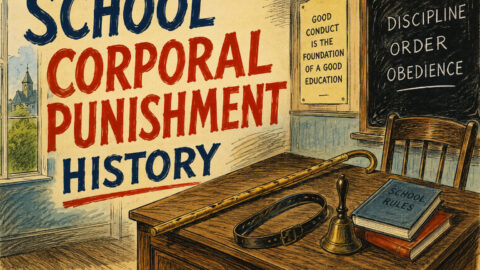
Once regarded as an ordinary instrument of school discipline, corporal punishment remains among the more controversial features of British education in earlier decades. Former pupils recall a world of headmasters’ studies, punishment books, slippers and canes, while contemporary fiction provides its own revealing portrait of prevailing attitudes.
To anyone educated in Britain during the 1950s and 1960s, the cane and slipper require little introduction. They were by no means employed in every school with equal enthusiasm, but in some establishments they occupied a conspicuous place in the disciplinary system.
One former pupil recalls attending both a private school and a grammar school in Cornwall during the 1960s. In his memory, both establishments acquired reputations for their readiness to resort to corporal punishment, although the private school was considerably the stricter of the two.
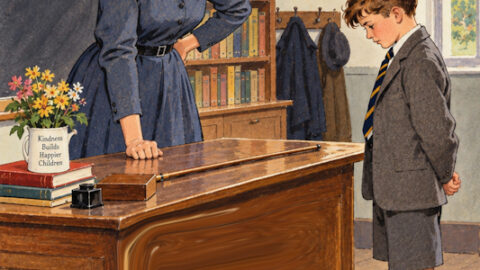
At that establishment, serious disciplinary matters were referred to the headmaster. The punishment might vary according to the offence, from a comparatively small number of strokes for minor misconduct to a considerably heavier punishment for what was regarded as serious misbehaviour.
The former pupil estimates that he was sent for such punishment two or three times during an average term. Afterwards came another ordeal familiar to generations of schoolchildren: returning to the classroom in the knowledge that everybody would immediately realise where one had been.
The school was co-educational. Girls could also receive corporal punishment, although, according to this recollection, considerably less frequently than boys.
At the boys’ grammar school which the contributor subsequently attended, the slipper might be used for lesser offences while the headmaster or deputy headmaster dealt with more serious matters. An adjoining girls’ grammar school apparently also retained corporal punishment, though again its use appears to have been less frequent.
Such accounts inevitably raise the question of parental attitudes.
In this particular case there was no conflict between home and school. The pupil’s parents firmly approved of corporal punishment. Indeed, at his admission interview, the headmaster warned his father that misconduct could result in corporal punishment. Far from objecting, his father regarded firm discipline as one of the reasons for selecting the school.
This attitude would hardly have been extraordinary at the time. Many parents believed that teachers stood in loco parentis and ought to possess considerable authority over children entrusted to their care.
Another former grammar-school pupil remembers the plimsoll being commonly employed by classroom teachers, while the cane was reserved for the headmaster and deputy head.
Others recall schools where the cane could be administered either to the hand or elsewhere, depending upon local custom.
There was, in short, no single British system.
Rules differed from county to county, school to school and sometimes teacher to teacher. What united these experiences was the widespread assumption that physical punishment remained a legitimate instrument of education.
That assumption would eventually be challenged with increasing force.