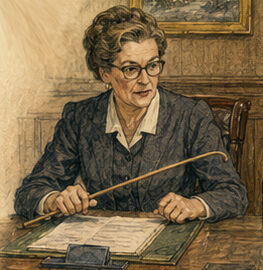
Mrs Edith Bellamy taught the youngest boys. She was a small, round woman with bright blue eyes and a voice that could change from motherly warmth to military sharpness in the space of a sentence.
Her classroom smelled of chalk, floor polish and poster paint. Along the walls hung multiplication tables, maps of the Empire and examples of exceptionally neat handwriting.
Mrs Bellamy was affectionate towards nervous newcomers. She tied shoelaces, found lost scarves and kept a tin of barley sugar for boys who felt faint during morning prayers. Yet she demanded instant obedience.
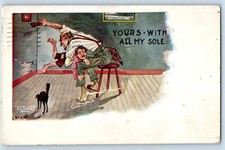
Her principal instrument of correction was a broad gym slipper kept in the bottom drawer of her desk.
The drawer itself became legendary.
When it opened, conversation ceased.
A boy who whispered repeatedly, flicked ink or failed to complete his sums might be ordered to the front.
“Bend over the chair, Hopkins.”
The rest of the class would stare determinedly at their exercise books while Mrs Bellamy administered several brisk smacks to the seat of the offender’s grey shorts.
“Thank you, Ma’am,” the boy was required to say afterwards.
“Return to your place, and let us see whether your arithmetic has improved.”
Mrs Bellamy also used a wooden ruler across the palm for untidy work. Boys attempted to soften the blow by holding their hands loosely or withdrawing them at the last instant.
She knew every trick.
“Hand still, Palmer. You are being corrected for carelessness. Do not compound it with cowardice.”
Despite her severity, many boys remembered her fondly. She rarely bore a grudge, and once a punishment had been given, the matter was finished.