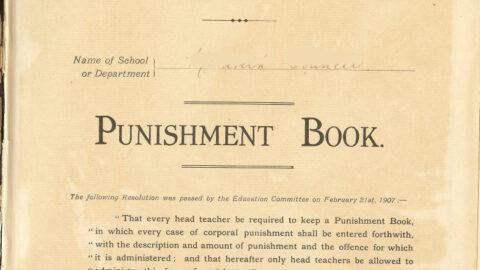
Looking back on my school years, I have always considered myself to have been a reasonably well-behaved child who was fortunate to grow up with caring and conscientious parents. Like most children, I occasionally found myself in trouble, but it was seldom through deliberate misbehaviour or persistent rule-breaking. More often than not, any punishment I received was simply part of growing up within a school system that placed great emphasis on order, discipline and respect for authority.
One lesson my brothers and I learned at an early age was that complaining to our parents about what we considered unfair treatment at school was almost always futile. If an entire class was punished because the guilty individual refused to admit responsibility, or if a teacher appeared to have acted harshly, our parents rarely questioned the school’s actions. Their response was remarkably consistent. They would explain that teachers had difficult jobs, that there was probably a reason for the punishment which we did not fully understand, or that any apparent injustice was balanced by occasions when children escaped punishment despite deserving it.
As children, we naturally felt aggrieved when we believed we had been treated unfairly. Yet those conversations taught us an important lesson that extended far beyond the classroom: life is not always perfectly fair, and authority figures sometimes have to make decisions with incomplete information. Whether or not that philosophy would be considered appropriate today is open to debate, but it undoubtedly shaped our expectations of the world.
At that time there was also a remarkable degree of consistency between the various adults who influenced children’s lives. Parents, teachers, grandparents, neighbours, youth leaders, sports coaches and other respected adults generally reinforced the same standards of behaviour. Although individual personalities differed, there was broad agreement that children should show respect, obey reasonable instructions and accept the consequences when they failed to do so. Adults presented a united front, leaving very little opportunity for children to play one authority figure against another. That consistency created clear expectations and contributed to a stable disciplinary environment, even if children did not always appreciate it.
Within schools themselves, discipline was not simply about administering punishment; it also reflected a carefully structured hierarchy of authority. In England, many schools operated what could reasonably be described as a two-tier disciplinary system. This distinction was not necessarily based upon the amount of physical pain involved but rather upon the seriousness attached to the offence and the symbolism of the punishment itself.
It is important to distinguish between the concepts of severity and seriousness, as they are often mistakenly treated as though they were identical. In practice they referred to different aspects of school discipline.
A punishment could be physically severe without necessarily being regarded as especially serious. The slipper, for example, could be extremely painful depending upon how and by whom it was administered. In purely physical terms it was often every bit as unpleasant as the cane and, in some cases, may have been remembered as the more painful of the two.
The cane, however, carried a very different significance. It was generally reserved for the headteacher or another senior member of staff and was used only for more serious breaches of school discipline. Receiving the cane therefore represented far more than simply experiencing another painful punishment. It marked a clear escalation in the disciplinary process and signalled that a pupil’s behaviour had crossed an important threshold.
For most pupils, the psychological impact of being sent to the headteacher was considerable. It was no longer a routine classroom punishment for talking, failing homework or minor disruption. Instead, it conveyed the message that the offence was regarded as genuinely serious and that the matter required the attention of the school’s highest authority.
The distinction between classroom discipline and headteacher discipline reinforced the seriousness of repeated or significant misconduct. A pupil might accept a routine classroom punishment with a degree of resignation, but being summoned to the headteacher’s office created a very different emotional response. The sense of apprehension often arose long before any punishment was administered. The unfamiliar setting, the authority of the headteacher and the knowledge that one had committed a particularly serious offence all combined to make the experience memorable.
This graduated approach offered certain practical advantages. Teachers could deal quickly with everyday disciplinary issues themselves, maintaining order without constantly referring pupils to senior staff. Meanwhile, genuinely serious cases remained exceptional, preserving both the authority of the headteacher and the symbolic importance of the cane.
By contrast, some education systems relied upon a single implement for virtually every level of disciplinary offence. While there might still have been differences in who administered the punishment or in the number of strokes given, the fundamental method remained unchanged regardless of whether the offence was relatively minor or considerably more serious.
Using the same form of punishment across the entire disciplinary spectrum arguably reduced the sense of progression within the system. Although being referred to the headteacher still represented an increase in authority, the punishment itself was essentially familiar. The psychological distinction between ordinary classroom misbehaviour and more significant offences could therefore become less clearly defined because pupils encountered the same basic form of discipline throughout their school careers.
Other countries adopted yet different approaches. In some schools, classroom punishments remained relatively limited while corporal punishment was reserved almost exclusively for serious misconduct and administered by senior staff. In these cases, differences in both the method and the circumstances under which punishment was given reinforced the distinction between routine disciplinary corrections and exceptional sanctions.
Whatever one’s opinion of corporal punishment today, it is worth recognising that many historical school disciplinary systems were designed with a structured progression in mind. The objective was not simply to inflict discomfort but to communicate varying degrees of seriousness through differences in authority, setting and procedure. Physical pain formed only one part of the experience. Equally important was the symbolism attached to who administered the punishment, where it took place and what it signified within the school’s wider framework of discipline.
Modern educational practice has moved away from corporal punishment altogether, reflecting changing social attitudes towards children’s welfare and behaviour management. Nevertheless, examining these earlier systems provides valuable insight into how schools once sought to balance everyday classroom discipline with more formal sanctions, and how psychological factors often played as significant a role as the punishment itself in maintaining order and reinforcing authority.