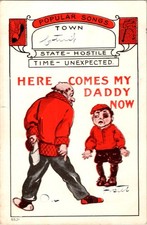
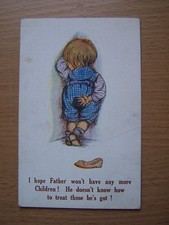
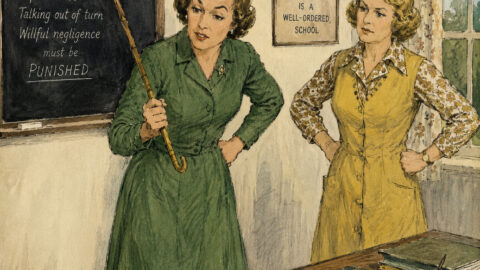
The history of corporal punishment in schools often focuses on one particular issue: the image of male teachers administering physical punishment to female pupils. This has become one of the most controversial aspects of educational discipline in retrospect. However, far less attention has been given to the reverse situation, where female teachers punished boys, often in ways that would almost certainly be considered unacceptable today.
During the 1950s, 1960s and well into the 1970s, it was not uncommon for female teachers, particularly in infant and junior schools, to administer corporal punishment to boys. Many schools regarded this as perfectly normal, and few parents questioned the practice.
One example comes from my own family. Around 1965, when my grandson was six years old, he was sent to the headmistress for misbehaviour. Her punishment was to place him over her knee and smack his bare bottom. At the time, neither the school nor the parents considered this unusual. It was viewed simply as part of maintaining discipline.
Another incident occurred in 1974 at Auriol Middle School. A male teacher was called away unexpectedly while boys were changing and showering after games. A female teacher stepped in to supervise the changing room in his absence. She remained while the boys showered and dressed, ensuring order was maintained. A number of boys who misbehaved were punished with the school slipper across their bottoms.
No complaints were made by pupils or parents. The prevailing attitude was that the teacher herself was a mother with sons and that there was nothing improper about her supervising boys in a changing room or administering punishment when necessary.
What makes this particularly interesting is what happened only a few months later. A newspaper reported a very different reaction when a male teacher, himself the father of two daughters, supervised girls in similar circumstances after being left in charge. Although he did not physically punish any of the girls, parents reacted with outrage simply because he had been present while they were changing.
The contrast between these two incidents highlights the very different standards that existed at the time. Female teachers supervising boys in vulnerable situations—or even administering corporal punishment involving the removal of clothing—was widely accepted. Male teachers, however, were increasingly viewed with suspicion if they found themselves in equivalent situations involving girls, even when no punishment was administered.
These differing attitudes reflected broader social assumptions. Women were generally regarded as naturally nurturing and trustworthy around children of either sex, whereas men were often judged by a different standard, particularly when girls were involved. Whether these assumptions were fair is open to debate, but they undoubtedly influenced school policies and public opinion throughout much of the twentieth century.
A Remarkable School Punishment Book
One particularly fascinating surviving record of school discipline is an early twentieth-century punishment book, which provides a detailed insight into how schools documented corporal punishment.
According to the auction description, the register contains the following columns:
- Entry number
- Name of pupil
- Offence
- Date of offence
- Punishment awarded
- Date punishment carried out
- Remarks
- Initials of the manager, clerk or inspector
It is not entirely clear from the available photographs whether the final two headings were separate columns or combined into one.
The first surviving page appears to show the entry number together with the pupil’s name and offence. The numbering system seems to restart each year. For example, there are twenty-seven recorded punishments during 1916 before the numbering begins again at one for the first offence recorded in 1917.
The second page appears to contain the names of pupils, descriptions of offences and the dates on which those offences occurred.
The third page seems to record the punishment itself, the date it was administered and a final column that may contain remarks, signatures or initials.
One particularly intriguing feature is the handwriting found in this final column. At first glance it seems logical to assume these are the names of the teachers administering the punishment. After all, recording the pupil’s name twice would appear unnecessary. However, the style of writing raises doubts. Several entries include both given names and surnames written in a manner that seems inconsistent with official record-keeping by teachers.
This has led to the possibility that these names were actually written by the pupils themselves. If so, they may have been required to sign or acknowledge the punishment after it had been administered.
Supporting this theory is an unusual entry involving a girl named Maria Viola, who was punished for truancy. Alongside the offence appears a shakily written version of her name, with her surname misspelt. Such uncertain handwriting could suggest a child writing under stress or nervousness rather than a teacher making an official entry.
Of course, other explanations are possible. The pupil may have signed the register before punishment was administered, or the punishment itself may not have affected the writing hand. Traditionally, caning was often delivered to the non-writing hand, although this was by no means universal. Unfortunately, the register provides no indication of where the punishment was administered, leaving historians to speculate.
The Severity of School Punishments
The offences recorded in the punishment book also provide a revealing glimpse into the values and priorities of schools at the time.
Some punishments appear understandable by contemporary standards. Receiving ten strokes for serious misconduct towards girls, which may well have been a euphemism for molestation or sexual harassment, reflected the gravity with which such behaviour was viewed.
Other entries, however, are more surprising.
Playing cards at school attracted the same punishment of ten strokes. Even more puzzling is the offence of playing bandy—a game similar to ice hockey—which also resulted in ten strokes. It is difficult today to understand why participating in a sporting activity could be considered as serious as behaviour involving the mistreatment of others.
Equally curious is the apparent inconsistency in punishments. Drinking spirituous liquor at school, something modern readers would regard as an extremely serious offence, resulted in eight strokes—fewer than were given for playing cards or playing bandy.
There are also numerous entries relating to failures in school etiquette. No fewer than five offences concern children failing to bow correctly, most of which attracted four strokes. By contrast, failing to address a teacher correctly resulted in only two strokes.
These records remind us that discipline in earlier generations reflected a very different set of social values. Respect, obedience, conformity and strict observance of school rules were often considered every bit as important as preventing more obviously harmful behaviour. The punishment book therefore offers not only a record of corporal punishment but also a fascinating window into the priorities, customs and culture of schools during the early twentieth century.