Official punishment books provide an intriguing glimpse into the use of corporal punishment in British schools during the mid-twentieth century. They record formal incidents where pupils were caned or otherwise punished by the headteacher or another senior member of staff. At first glance, these records can suggest that corporal punishment was relatively uncommon, reserved only for the most serious offences.
However, the experiences of many former pupils tell a rather different story. While formal punishments may have been carefully documented, the day-to-day reality inside classrooms was often very different. Countless routine punishments administered by individual teachers never appeared in any official record, creating a misleading impression for anyone relying solely on surviving punishment books.
Formal Punishments Were Only Part of the Story
One former pupil recalled attending a mixed primary school in Willesden, North-West London, between 1954 and 1961. Looking back, the official punishment book from that period would probably suggest that corporal punishment was only used occasionally.
During those years, pupils would sometimes hear that someone had received “four of the best” with the cane. Four strokes appeared to be more common than six, but such incidents were relatively infrequent and quickly became the subject of whispered conversations throughout the school.
These formal canings were administered by the senior master and, possibly, on occasion by the headmistress, although pupils rarely witnessed them directly. One former pupil accidentally observed a caning through the glass panel of an empty classroom door as he walked past. A boy was standing with his hand out while the senior master administered the punishment.
On another occasion, a boy emerged from the headmistress’s office accompanied by the senior master. Although nothing was said, his obvious discomfort strongly suggested he had received a caning across the seat of his trousers.
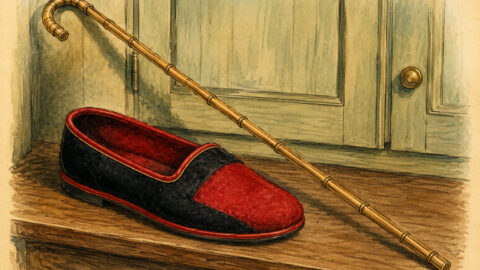
Although the school educated both boys and girls together, there was no recollection of girls receiving the cane. Girls could, however, be punished by the headmistress using a slipper. Such incidents were rare enough that on one occasion the headmistress announced at assembly that a girl had been slippered, perhaps intending it as a warning to the rest of the school.
To anyone examining only the punishment book decades later, the conclusion would seem straightforward: corporal punishment was an uncommon event.
The reality was considerably more complex.
The Classroom Was Where Most Punishments Took Place
The overwhelming majority of corporal punishment occurred inside ordinary classrooms during the school day and never appeared in any official register.
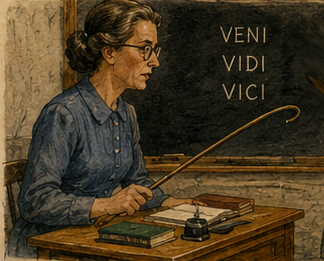
Most teachers carried out their own discipline without involving the headteacher. A child who disrupted a lesson, failed to complete work, talked out of turn or misbehaved could be punished immediately. There was no need to send them elsewhere or complete paperwork afterwards.
Many female class teachers routinely used a gym slipper, ruler or an open-handed smack to maintain order. These punishments were generally less severe than a formal caning but happened far more frequently. The punishment was swift, public and designed to restore discipline before the lesson continued.
Teachers would simply call the offending child to the front of the class, administer the punishment, and resume teaching as though nothing unusual had occurred. No entry was made in any book, and there was rarely any suggestion that one should be.
Although individual punishments were relatively minor compared with a caning from the headteacher, they formed a regular part of school life. Their cumulative effect on the atmosphere of the school was far greater than the occasional formal punishment recorded in official documents.
One former pupil estimated that while there may have been only half a dozen formal canings across the entire school during a year, the slipper alone might have been used half a dozen times in just the first fortnight of junior school—and that was in only one classroom out of eight. The particular female teacher responsible that term was acknowledged as using the slipper more frequently than most, but classroom corporal punishment was nevertheless regarded as entirely normal throughout the school.
Official Records Could Be Misleading
Several people with first-hand knowledge of schools from this period reached remarkably similar conclusions.
One recalled that his father had served first as deputy headteacher and later as headmaster. On a few occasions he managed to discreetly examine the school’s punishment book.
The entries closely resembled surviving punishment books from other schools. They recorded relatively small numbers of serious punishments, usually involving canings carried out by the headteacher for offences such as persistent disobedience, fighting, theft or repeated misconduct.
Yet these official entries represented only a fraction of the corporal punishment actually taking place.
Most classroom punishments administered by female teachers—and occasionally by male teachers—never appeared in the book at all.
Years later, during the school’s seventy-fifth anniversary celebrations in the 1990s, he again examined the punishment book. He noticed a marked change after his father’s retirement. His successor, who became headteacher during the mid-1960s, appeared to use the cane significantly more often and with greater severity than had previously been the case.
By that stage, classroom corporal punishment had largely disappeared from the school, with serious discipline becoming concentrated in the headteacher’s office. It raised an interesting possibility: had the earlier system of frequent but relatively mild classroom punishments prevented more serious offences from developing?
Different Schools, Different Systems
Experiences varied considerably from one school to another, even within Britain.
In another junior school, classroom corporal punishment was used throughout the school. Both boys and girls could receive slipperings, ruler smacks or hand smacks from their classroom teachers. These punishments were accepted as part of everyday discipline and were administered immediately whenever teachers considered them necessary.
Theoretically, pupils could have been sent to the headmaster for caning, but this appears to have been extremely unusual in the junior department. Most former pupils never regarded it as a realistic consequence of ordinary childhood misbehaviour.
The senior school operated differently. There, formal canings by the headmaster occurred much more regularly and were officially recorded.
This distinction illustrates how disciplinary systems could vary not only between schools but even between different departments within the same school.
Why Were So Many Punishments Never Recorded?
One of the enduring historical questions concerns the purpose of punishment books if they documented only selected incidents.
There is little evidence that every education authority required every act of corporal punishment to be recorded. In many schools, punishment books appear to have been reserved for formal sanctions administered by the headteacher or senior staff.
Routine classroom discipline remained the responsibility of individual teachers, who exercised considerable discretion. Unless a punishment was unusually severe or involved referral to the headteacher, no official record was normally created.
As a result, surviving punishment books almost certainly understate both the frequency and the everyday significance of corporal punishment in many schools.
Historians relying exclusively on these records may therefore underestimate how commonplace corporal punishment actually was in ordinary classroom life.
The Challenge for Historical Research
This selective record-keeping presents obvious problems for researchers attempting to measure the prevalence or effectiveness of corporal punishment.
If only formal punishments were documented while the majority of classroom punishments went unrecorded, statistical analysis based solely on punishment books becomes inherently unreliable. Rates of punishment, repeat offending and disciplinary effectiveness cannot be accurately calculated from incomplete records.
Meaningful historical comparisons require school systems where regulations insisted that every instance of corporal punishment be administered centrally, witnessed and formally entered into official records. Only under such tightly controlled procedures can researchers have reasonable confidence that surviving documentation reflects actual practice.
A Different Approach Overseas
Not every education system operated in the same way.
One former pupil described attending an elementary school where discipline followed a clearly defined two-stage structure.
During the first four grades, classroom corporal punishment was commonplace. Female teachers, and occasionally male teachers, dealt with minor misconduct themselves, usually by administering a few smacks to the child’s clothed bottom. These punishments were generally intended as immediate corrections rather than severe beatings, although some teachers occasionally used a thick ruler with considerably greater force.
From Grade 5 onwards, the system changed completely.
All corporal punishment took place in the headteacher’s office using a leather strap applied to the hands. Every punishment was witnessed, formally recorded and carried out according to established procedures. Classroom corporal punishment effectively disappeared from the upper grades, and discipline became centralised under senior management.
This structured approach provides historians with a much clearer documentary record than the more informal systems found in many British primary schools.
Looking Beyond the Punishment Book
Surviving punishment books remain valuable historical documents, but they should be interpreted with caution.
They faithfully record formal disciplinary actions administered by senior staff, yet they often fail to capture the routine reality experienced by generations of pupils. For many children during the 1950s and early 1960s, the most common forms of corporal punishment were not dramatic canings in the headteacher’s office but the everyday slipper, ruler or hand administered by classroom teachers as part of ordinary discipline.
Without recognising this distinction, official records risk presenting an incomplete picture of school discipline during an era when corporal punishment formed an accepted, if increasingly debated, element of educational life.