Discipline as Part of the Period Landscape
Robert Westall’s The Machine Gunners is particularly revealing because school punishment is not the principal subject of the novel.
It simply belongs to the world inhabited by its characters.
That perhaps tells us more about contemporary attitudes than a book specifically devoted to education.
Chas McGill and his companions live amid the dangers and excitement of wartime Britain. They collect fragments from bombing raids, quarrel among themselves, fight rivals and become involved in adventures far beyond the normal experience of schoolchildren.
Against this extraordinary background, school discipline remains thoroughly conventional.
Chas’s great rival is Bodser Brown, a larger boy and something of a bully. Their disputes eventually produce consequences at school, where fighting and other misconduct can bring swift punishment.
The standards imposed upon boys also reflected contemporary notions of respectable behaviour. Fighting might be tolerated within certain unwritten boundaries, but using an object as a weapon was regarded as crossing the line.
The headmaster and teachers therefore appear as representatives of a moral code which children might dislike but nevertheless understand.
Westall returned to Chas in the 1979 sequel, Fathom Five.
Two years have passed, and Chas becomes convinced that a spy is operating locally and passing information about shipping movements to the Germans.
The sequel contains considerably less school corporal punishment than its predecessor, although one particularly revealing detail concerns Chas’s friend Cem.
Cem is described as responding to punishment with almost uncontrollable laughter — not because he finds the experience amusing, but because laughter is his nervous reaction.
It is a small observation, but an interesting one.
Children did not necessarily respond to authority in predictable ways.
Some cried. Some attempted to appear indifferent. Some joked afterwards. Others apparently laughed from sheer nervousness.
This variety of responses is easily lost when discussing historical discipline purely in terms of regulations and statistics.
Literature preserves something different: atmosphere.
It records the whispered warnings between pupils, the reputation of a strict teacher, the apprehension of being summoned to the headmaster and the complicated mixture of resentment and respect children could feel towards adults in authority.
It is also worth remembering that novels are not documentary evidence.
A fictional punishment cannot establish what normally happened in British schools.
But authors generally expect readers to recognise the world they create.
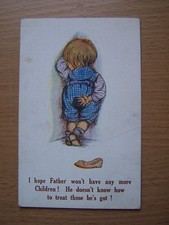
The casual appearance of the cane and slipper in post-war children’s fiction therefore tells us something significant.
For generations of British readers, these objects required no footnote.
Everyone knew what they meant.