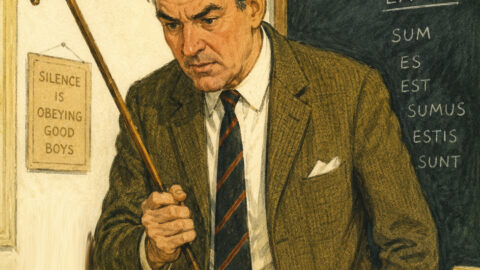
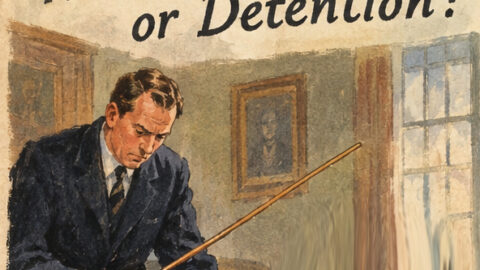
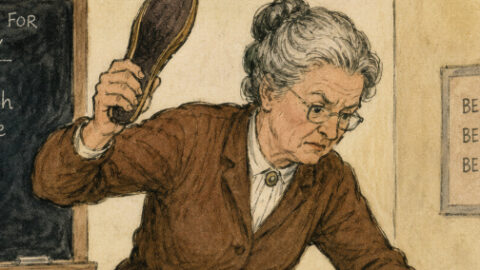
It would be too simple to portray every former pupil as permanently damaged by corporal punishment.
The recollections do not support such a conclusion.
Some people look back with humour.
Some insist that it did them no harm.
Some even express gratitude towards teachers who punished them.
Others remember fear, pain, humiliation or resentment.
Both kinds of recollection deserve attention.
What these memories demonstrate most clearly is that corporal punishment was not one uniform experience producing one uniform result.
It could create immediate obedience.
It could deter some children from repeating an offence.
It could establish a formidable atmosphere of authority.
But it could also fail repeatedly.
It could turn punishment into a contest between pupil and teacher. It could encourage children to conceal wrongdoing rather than reconsider it. It could humiliate pupils, foster resentment and punish children for offences that appear extraordinarily minor when viewed from a later age.
And, perhaps most troublingly, it placed the power to inflict physical pain upon children into the hands of individual adults whose personalities, tempers and attitudes inevitably differed.
Some teachers apparently regarded corporal punishment as an unpleasant duty.
Some former pupils continued to respect and even like teachers who had punished them.
Other pupils came away believing that particular teachers positively enjoyed wielding the cane, strap or slipper.
We cannot now know with certainty what those teachers actually felt.
But the fact that such impressions survived for decades tells us something about the relationship between physical punishment and authority.
Perhaps corporal punishment’s greatest strength and greatest weakness were actually the same thing.
It was simple.
A rule was broken.
A punishment followed.
There was little need to understand why a child was misbehaving, whether the rule itself was sensible, whether the punishment was proportionate or whether another approach might have worked better.
For a busy school, that simplicity must sometimes have been attractive.
But education is rarely simple.
The memories left behind by those schoolchildren — now adults looking back across half a century or more — suggest that pain could certainly command attention.
What it could not reliably command was understanding.
The cane could make a classroom quiet.
It could make a child afraid.
It could sometimes stop an offence from being repeated.
But the countless stories of pupils who were caned, strapped or slippered time and again suggest that physical punishment was never the wonderfully efficient cure for bad behaviour that nostalgia can occasionally make it appear.
Its legacy is therefore a decidedly mixed one.
For some, it was a brief unpleasantness belonging to another age.
For others, it became an amusing school story.
For some it represented firm discipline which, looking back, they still believe did them good.
And for others, the memory remained remarkably sharp decades later — the teacher, the office, the waiting, the embarrassment and the punishment itself all surviving long after most ordinary lessons had faded from memory.
Perhaps that is the most revealing result of all.
The punishment may have lasted seconds.
The memory could last a lifetime.