Miss Blyton’s eyes rested briefly upon the iron ring before returning to the boys.
“So,” she said with a knowing smile, “I imagine you’ve discovered one of Highdon’s oldest mysteries.”
David looked surprised.
“You know about it, Miss?”
“A little,” she replied. “Although I suspect the stories have grown rather taller with each generation.”
Peter crouched beside the square stone once more.
“Do you think there’s really something underneath?”
Miss Blyton walked over and gently brushed a little more earth away with the toe of her shoe.
“When Highdon was first built, there were several service passages beneath the oldest buildings. Most were filled in many years ago. Whether this stone covers one of them, I couldn’t possibly say.”
Simon grinned.
“So there could be a secret tunnel?”
“There could,” she answered, “or it could simply be an old drainage inspection cover. Mysteries often prove less exciting once they’re solved.”
The boys laughed.
Miss Blyton closed one of her library books and looked around the quiet grounds.
“If you truly wish to discover Highdon’s history, you would do far better to visit the library than to spend all afternoon pulling at ancient stones.”
David smiled.
“I thought you might say that.”
“Come along after tea. I’ll show you some of the oldest photographs we have.”
With that she continued along the path towards the chapel, where the tall figure of Miss Bowflower, the Headmistress of Highdon, could be seen crossing the quadrangle.
Every boy recognised her at once.
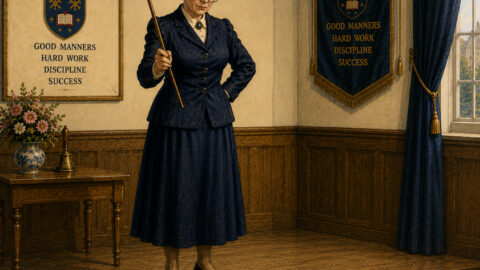
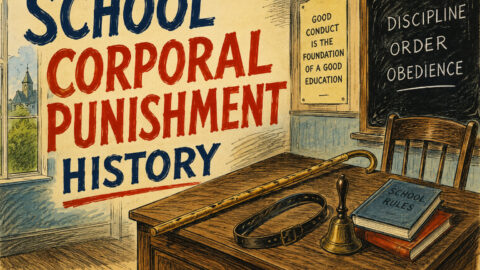
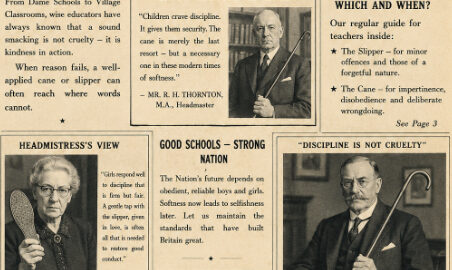
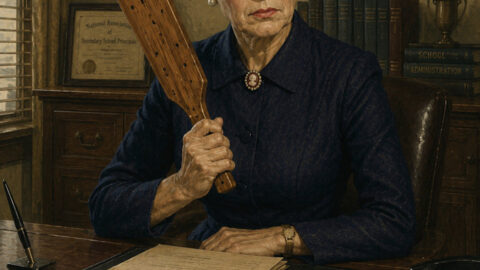
She carried herself with calm authority, dressed impeccably in her dark suit, and was respected throughout the school for being both fair and firm. Although she preferred good manners and honest effort to punishment, Highdon’s traditions remained under her care. For serious breaches of discipline, she still authorised the use of the school slipper or, on the gravest occasions, the cane, believing that both should be reserved for those rare moments when every other remedy had failed.
She exchanged a few quiet words with Miss Blyton before continuing towards the main building, the younger boys instinctively standing a little straighter as she passed.
“I like her,” Andrew said quietly.
“So does everyone,” David replied. “She’s one of the best teachers here.”
Peter looked once more at the stone.
“We’re coming back, aren’t we?”
“Oh, certainly.”
Tea that afternoon was noisier than usual.
The excitement of Saturday games had left everyone hungry, and the dining hall buzzed with conversation.
Senior boys discussed the rugby scores.
First-years exchanged stories about missed catches and muddy tackles.
At the staff table, the teachers spoke quietly amongst themselves.
Miss Harcourt occasionally glanced towards the younger tables, and conversations immediately became a little quieter whenever her eyes wandered in their direction.
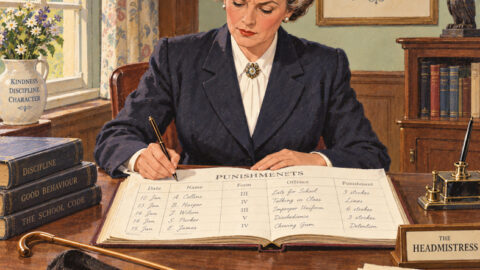
At the centre of the table sat Miss Bowflower. She listened more than she spoke, though from time to time a brief remark from her would have the whole staff smiling. Even so, every teacher knew she expected Highdon’s standards to be maintained, and when disciplinary matters arose she insisted that the school slipper or cane should be used only with proper judgement, careful records, and never in anger.
After the meal, David led his friends to the school library.
Few first-year boys had yet ventured inside.
The room occupied nearly the whole of the oldest wing.
Dark oak shelves stretched almost to the ceiling, reached by narrow rolling ladders that squeaked gently whenever they were moved.
Dust danced in the late afternoon sunlight.
Leather-bound volumes filled shelf after shelf.
To Andrew, it felt rather like stepping into another century.
Mr Henshaw, the elderly librarian, looked up over his spectacles.
“Ah,” he said. “The explorers have arrived.”
Miss Blyton smiled.
“I thought these young gentlemen might enjoy seeing a little of Highdon’s past.”
Mr Henshaw unlocked a tall glass cabinet.
Inside lay dozens of photograph albums, carefully labelled by decade.
The oldest dated back to the 1890s.
One by one, they turned the thick pages.
There were photographs of boys in straw boaters standing beneath the very cedar tree they had visited earlier.
Another showed the school during heavy snow, with pupils building enormous snowmen outside Ash House.
There were cricket elevens from before the Great War, chapel choirs, brass bands and rowing crews smiling proudly beside polished trophies.
“It hasn’t changed very much,” Simon observed.
Mr Henshaw chuckled.
“The buildings haven’t. The boys certainly have.”
David suddenly stopped turning the pages.
“Look at this.”
The photograph showed the chapel exactly as it appeared today.
But beside it stood a small stone building that no longer existed.
“What happened to it?” Peter asked.
“It was demolished after a fire in the 1950s,” Mr Henshaw explained.
“Beneath it were several old storage cellars which were sealed for safety.”
David exchanged a glance with Simon.
“Near the cedar?”
“Very near indeed.”
The boys’ excitement returned instantly.
Mr Henshaw noticed.
“I can almost hear the questions forming.”
“Do the tunnels still exist?” David asked.
The old librarian smiled.
“I’ve worked here for nearly forty years.”
“And?”
“I’ve never found one.”
“But that doesn’t stop every generation of boys believing they’re about to.”
As evening approached, the chapel bell echoed softly across the grounds.
The library windows glowed with the last of the golden sunlight.
The boys carefully returned the heavy albums to the table.
They had not discovered buried treasure.
They had not uncovered a forgotten tunnel.
Yet somehow the mystery seemed even greater than before.
For Highdon had a very long memory.
And somewhere beneath its ancient bricks and spreading cedar tree, it still seemed to be keeping one or two secrets of its own.