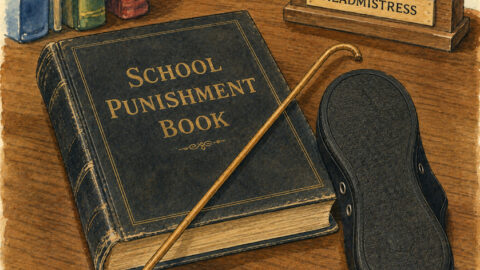
These recollections raise a question which educationalists continue to debate: should academic failure ever be treated as a disciplinary offence?
There is an obvious difference between refusing to work and being unable to work.
Yet in the classroom that distinction is not always easily made.
A teacher faced with thirty pupils cannot necessarily know whether the girl who has received 42 per cent failed because she neglected her homework, misunderstood the lesson, became nervous during the test or simply possesses little aptitude for the subject.
The schools represented in these recollections adopted markedly different approaches.
At one grammar school, poor work resulting from inability was accepted, while poor work attributed to laziness brought punishment.
Miss Cartwright’s “whack mark” provided a simple, if uncompromising, dividing line.
Miss Spencer’s history tests introduced a more playful variation, with the threat of “six of the best” for the pupil finishing last, although the rule could be waived when the general standard was sufficiently high.
Sister Brendan’s rapid mental-arithmetic sessions represented a sterner philosophy, in which speed and accuracy were expected and failure could have immediate consequences.
Miss Harris preferred additional written work.
Miss Whitmore established a fixed percentage beneath which punishment followed, even when illness provided a reasonable explanation for a pupil’s lack of knowledge.
Miss Bennett transformed the weekly French vocabulary test into something approaching classroom theatre.
What is striking is how strongly individual personality influenced school discipline.
The headmistress might establish the broad rules of the institution, but within her own classroom a mistress often possessed considerable discretion.
One teacher might overlook an offence which another considered intolerable.
A poor test result might mean nothing in one classroom, an additional essay in another and a visit to the front of the room in a third.
To the modern reader — and perhaps increasingly to educational opinion in the present decade — the notion of physically punishing a child for failing an academic test may appear questionable.
Fear can certainly produce concentration.
Whether it produces genuine understanding is rather less certain.
There is also the danger that the pupil begins to associate the subject itself with anxiety. The girl who repeatedly fails mathematics may require patient explanation rather than punishment. The pupil who cannot remember historical dates may nevertheless possess an excellent understanding of history.
Yet it would be misleading to portray every recollection as one of unrelieved misery.
Schoolchildren themselves often distinguished between genuinely frightening punishments and those regarded as ritual, comedy or classroom theatre. Some teachers who employed such methods were nevertheless remembered with considerable affection.
Others most certainly were not.
Perhaps that is the clearest lesson to emerge from these accounts.
The school discipline of the 1960s cannot easily be reduced to a single rule or experience. It was shaped by institution, tradition, circumstance and personality.
Above all, it was shaped by the woman standing at the front of the classroom — whether the formidable Sister Brendan, the eccentric Madame Poulet, the theatrical Miss Bennett or the uncompromising Miss Whitmore.
For generations of former pupils, the examination marks themselves have long since been forgotten.
The teachers who handed them out have proved rather more difficult to erase from memory.