Like many traditional British grammar schools of the era, the school day revolved around strict routines, compulsory assemblies, and an uncompromising approach to discipline. Success often depended less on academic ability than on learning the unwritten rules of school life—knowing where to be, who to avoid, and how to recover gracefully when things inevitably went wrong.
Missing Registration: The Honest Approach
Oversleeping happened to everyone at some point. Missing morning registration was never ideal, but there was a surprisingly simple way of limiting the consequences.
The best course of action was to find your form teacher immediately after assembly and before the first lesson began. A straightforward apology, coupled with accepting responsibility for arriving late, usually went a long way.
Teachers had heard every excuse imaginable. They could spot an implausible story a mile away, so trying to explain your absence with some wildly improbable tale was rarely worth the effort. A simple admission that you’d overslept was often received far more favourably than an elaborate fabrication.
Many teachers respected honesty, even when they couldn’t overlook the lateness itself. The punishment, if there was one, was often considerably lighter than it would have been for someone caught inventing excuses.
The Art of Avoiding Assembly
Of course, not everyone chose the honest route.
For those determined to avoid assembly altogether, there was a well-practised strategy that relied on careful timing and an intimate knowledge of the school’s geography.
The trick was to attend registration as normal so that your name was marked present. Once the register had been completed, you quietly slipped away upstairs, making your way along the rear corridor past the Chemistry and Physics laboratories before reaching the landing overlooking the school’s main entrance.
From this vantage point you could monitor the daily movements of senior staff.
Every morning unfolded with almost military precision.
The Lower School Head would make his way towards the junior assembly hall while, almost simultaneously, the Headmaster would walk beneath the stone cloisters towards the main hall. Their routines were astonishingly consistent. After a few weeks, pupils could predict their movements almost to the minute.
Once both had disappeared into their respective assemblies, the corridors became remarkably quiet.
For a short while at least, you were effectively invisible.
Some boys used this opportunity simply to enjoy a few minutes of peace before lessons began. Others disappeared into the toilets, where they could sit quietly with a cigarette—on the days they had managed to acquire one—and read the morning newspaper in complete tranquillity before returning to class as though nothing unusual had happened.
It was hardly an official morning routine, but for those who disliked assembly, it became something of an art form.
Discipline Was Simply Part of School Life
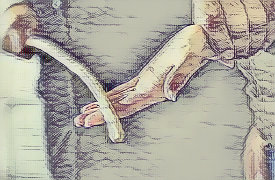
Looking back, one of the most striking differences between schools was not whether corporal punishment existed, but how frequently it was used.
Some schools employed it only for the most serious offences.
Others regarded it as a routine disciplinary measure that sat comfortably in the middle of a broad range of punishments.
At our school it unquestionably belonged to the latter category.
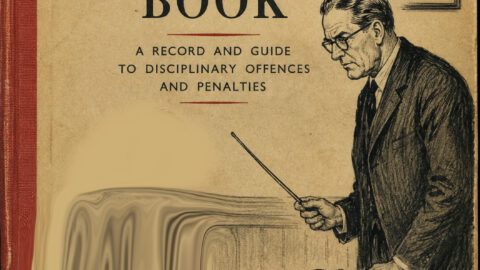
With more than a thousand pupils on roll, discipline was administered by several members of the senior teaching staff. Responsibility did not rest solely with the Headmaster; housemasters and other senior teachers were also authorised to deal with disciplinary matters, creating a system in which punishment could be delivered quickly whenever staff felt it necessary.
Because the school included boarding pupils, discipline extended far beyond normal classroom hours. Staff exercised responsibility throughout the day and evening, reflecting the principle of in loco parentis—acting in the place of parents. Living under continual supervision inevitably created more opportunities for rules to be broken and, consequently, more occasions when punishments were imposed.
Not Reserved for the Worst Offences
Contrary to what many people assume today, corporal punishment was not generally reserved for exceptionally serious misconduct.
Persistent lateness, missing detention, smoking, repeated disobedience, poor attitude, or simply accumulating too many minor offences could all eventually result in a visit to the Headmaster’s study or another senior teacher’s office.
It functioned as an intermediate sanction—more severe than a detention but falling well short of suspension or expulsion.
As a result, receiving the cane was not an extraordinarily rare event.
Many pupils experienced it once during their school career, particularly during the middle years. Others managed to avoid it altogether, while a small number, usually those who repeatedly challenged authority, became rather familiar with the experience.
Academic performance offered no guaranteed protection either. Well-behaved pupils in the top sets generally escaped disciplinary attention, but anyone whose attitude deteriorated or whose behaviour became consistently troublesome could eventually find themselves on the receiving end of school discipline.
Different Schools, Different Experiences
Comparisons with other grammar schools reveal just how much disciplinary culture varied from one institution to another.
Some schools recorded relatively few corporal punishments each year, reserving them for only the gravest breaches of discipline.
Others used the cane far more frequently as part of everyday school management.
With well over a thousand boys attending and several senior staff empowered to administer corporal punishment, it was entirely possible for multiple punishments to be carried out on a single day, particularly following repeated offences such as smoking or failing to attend detention.
Viewed over the course of five school years, the statistical likelihood of a pupil receiving at least one caning was probably greater than many people today would imagine.
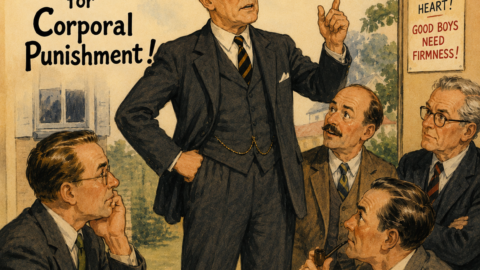
For most boys it became simply another aspect of school life—something respected, sometimes feared, occasionally joked about afterwards, but rarely questioned because it formed part of the accepted educational culture of the period.
Looking Back
Modern readers may find many of these routines difficult to imagine. Morning assemblies were compulsory, discipline was highly visible, teachers exercised considerable authority, and pupils developed countless ingenious ways of navigating the system while staying just on the right side of serious trouble.
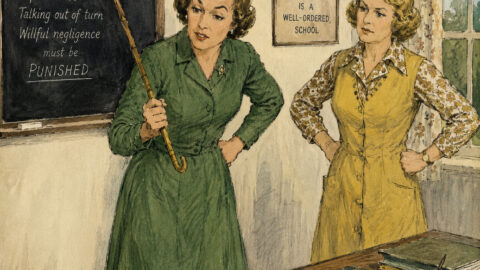
The overwhelming majority of teachers were dedicated professionals who cared deeply about their pupils’ education and welfare. Around four-fifths of the staff were women, particularly in subjects such as English, Modern Languages, Music, Art and the lower years, while approximately one-fifth were men, many of whom occupied senior pastoral, sporting or science roles. Despite differences in personality and teaching style, most shared the same expectations of punctuality, respect and good conduct.
For the pupils, school life became a mixture of routine, discipline, humour and ingenuity. Learning how to survive the daily rituals—whether by owning up to missing registration, timing an escape from assembly with military precision, or simply keeping out of trouble—was every bit as much a part of their education as anything taught in the classroom.
As Leonard Cohen later wrote in The Future:
“When they said repent, I wonder what they meant?”
For many former pupils, that line captures perfectly the mixture of authority, discipline and adolescent bewilderment that characterised a very different era of British schooling.