Formal canings naturally occupy a prominent place in recollections of school discipline. They were serious occasions and were therefore more likely to be remembered many years afterwards.
Yet the survey suggests that the formal visit to the headmaster represented only part of the story.
For many pupils, the more familiar experience was the ordinary classroom punishment.
This might consist of one or two strokes administered by the teacher and followed by an immediate return to the lesson.
An Everyday Occurrence
One contributor, who attended a Catholic primary school in Lancashire during the 1960s, described classroom caning as an everyday event.
Talking could be sufficient to bring one or two strokes.
According to this recollection, teachers possessed their own canes and several pupils might be punished during the same lesson.
On one memorable occasion, the contributor recalled an entire class being punished.
Whether such extensive use was typical cannot be determined from one account.
It does, however, demonstrate how routine corporal punishment could become within a particular school.
Discipline Without the Headmaster
This routine use of corporal punishment explains why official punishment books must be approached cautiously.
A headmaster might carefully record every formal caning.
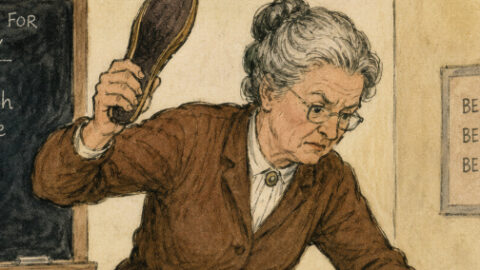
Meanwhile, teachers elsewhere in the building could be administering the slipper or ruler without making any permanent record at all.
A future historian examining only the punishment book might consequently conclude that physical punishment was comparatively rare.
Former pupils may remember otherwise.
Speed and Convenience
The classroom punishment possessed one obvious advantage from the teacher’s point of view: speed.
A pupil who talked repeatedly could be warned, punished and returned to his desk within a short period.
There was no need to prepare a report or send the child to another member of staff.
The lesson could continue.
In an age of large classes, this simplicity may have contributed to the popularity of immediate punishment.
The Danger of Routine
But there was another side.
A punishment used too frequently risked losing its significance.
If pupils saw classmates punished every day, the event ceased to be extraordinary.
For some children this may have reduced its deterrent value.
The teacher then faced the familiar difficulty of increasing the punishment or referring the pupil to a more senior authority.
Thus a disciplinary ladder developed almost naturally.
A warning stood at the bottom.
Then might come lines or detention.
Then the slipper or a minor caning.
At the top stood the formal visit to the headmaster.
What the Records Miss
The distinction between recorded and unrecorded punishment is one of the most important findings in the material.
It means that no surviving punishment book can necessarily tell us how frequently corporal punishment was actually used in a school.
It tells us only what was recorded.
For a full picture we require both official documentation and personal testimony.
The headmaster’s cane may have left an entry in a ledger.
The classroom slipper frequently left nothing except a memory.